
CameraBench
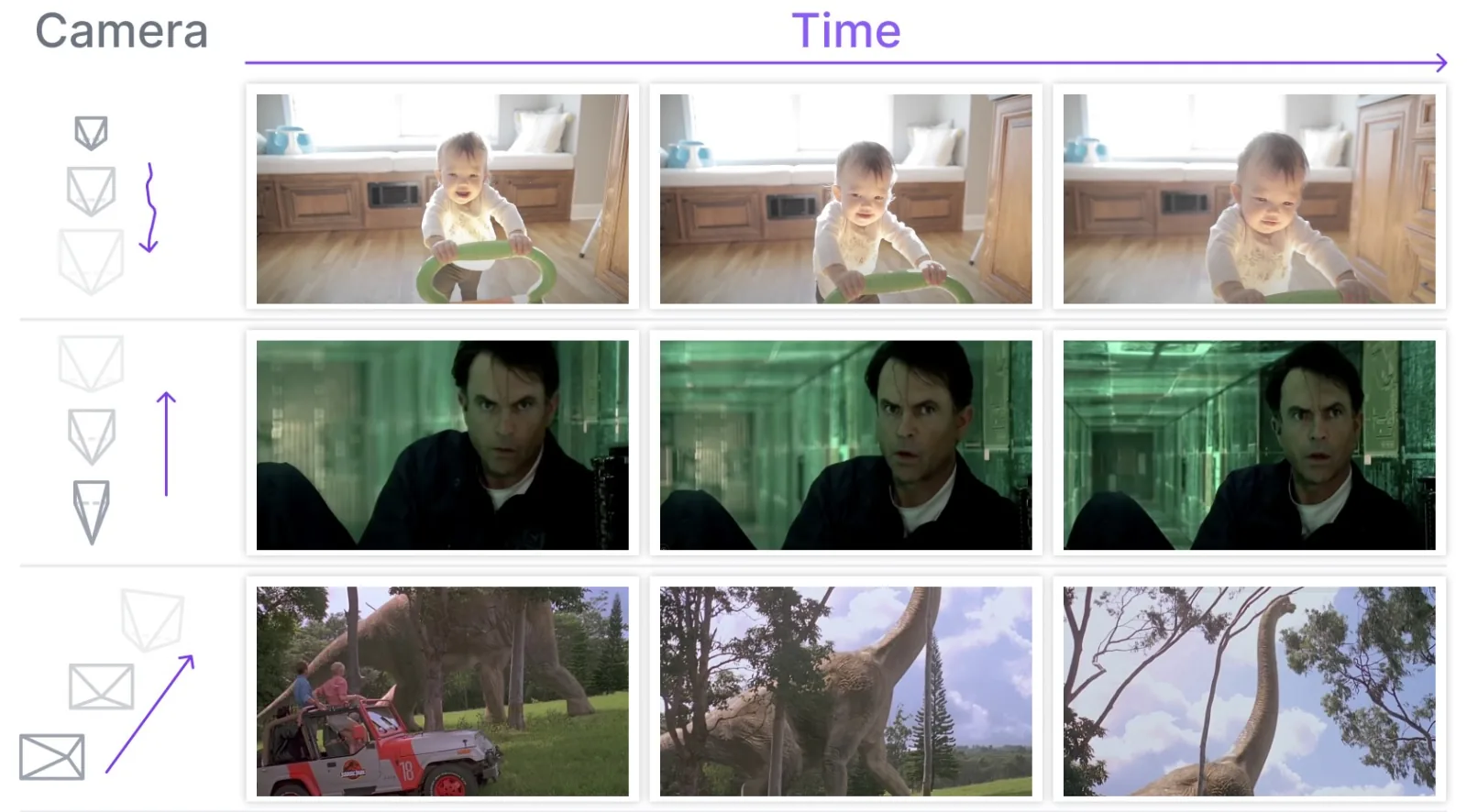
CameraBench (Carnegie Mellon) asks whether a video model understands camera motion — pan, tilt, dolly, and the rest of a cinematographer-designed taxonomy, refined by expert annotation. Four families:
- Binary classification —
camera_motion_average_precisionandcamera_motion_roc_auc. - VQA — yes / no and question accuracy about the camera.
- Retrieval — text, image, and group retrieval of matching motions.
- Caption — caption quality. GPT judging is opt-in (
OPENAI_API_KEY, disable with--no-gpt).
camerabench_average is the mean over available official families. In WorldFoundry the same labels can also seed camera-control generation prompts; that is a downstream use, not a hidden leaderboard.
Paper: CameraBench. Project: linzhiqiu.github.io/papers/camerabench. Code: sy77777en/CameraBench, scoring stack linzhiqiu/t2v_metrics. Data: syCen/CameraBench (CC-BY-4.0).
WorldFoundry aggregates prepared score_dir files or imports official JSON. VLM / SfM score generation stays upstream. Shared geometry stack: camera_geometry_stack (VGGT, MoGe, UniDepth, RAFT).
Dimensions
- Binary camera-motion classificationKindTask
Average precision and ROC AUC over expert-annotated camera-motion primitives.
- Camera-motion VQAKindTask
Yes/no and question accuracy about camera motion.
- Camera-motion retrievalKindTask
Text, image, and group retrieval of matching camera motions.
- Camera captioningKindTask
Caption quality over camera-motion descriptions. GPT judging is opt-in.
Data composition
- Size
CMU CameraBench testset (syCen/CameraBench): expert-annotated camera-motion videos with binary, VQA, retrieval, and caption families.
- Sources
syCen/CameraBench · github.com · github.com
- Modalities
video · camera · text
- License
cc-by-4.0
- Notes
WorldFoundry aggregates prepared score files or imports official JSON. VLM / SfM score generation stays upstream.
Metrics
Metric
- DirectionHigher is better
camera_motion_average_precisionCameraBench binary-classification mean average precision.
- DirectionHigher is better
camera_motion_roc_aucCameraBench binary-classification ROC AUC.
- DirectionHigher is better
camera_vqa_accuracyMean of CameraBench yes/no binary and question accuracy.
- DirectionHigher is better
camera_retrieval_accuracyMean of CameraBench text, image, and group retrieval scores.
- DirectionHigher is better
camera_caption_scoreMean caption score from official CameraBench caption evaluation outputs.
- DirectionHigher is better
camerabench_averageMean over available official CameraBench metric families.
PrimaryCameraBench Average
Leaderboard
Official live board, embedded on this page. Not WorldFoundry-run scores. sy77777en.github.io/CameraBench.
How to run
Import official JSON (strict coverage):
WORLDFOUNDRY_CAMERABENCH_STRICT=1 worldfoundry-eval zoo benchmark-run \
  --benchmark-id camerabench \
  --mode official-validation \
  --official-results-path <official_results.json> \
  --benchmark-data-root <camerabench_data_root> \
  --output-dir tmp/camerabench/official-validation \
  --json
Aggregate a prepared score directory:
WORLDFOUNDRY_CAMERABENCH_STRICT=1 worldfoundry-eval zoo benchmark-run \
  --benchmark-id camerabench \
  --mode official-validation \
  --score-dir <score_dir> \
  --benchmark-data-root <camerabench_data_root> \
  --output-dir tmp/camerabench/score-dir \
  --json
hf download syCen/CameraBench --repo-type dataset \
--local-dir cache/worldfoundry/data/hfd_datasets/syCen/CameraBench--task restricts to one family. Env: WORLDFOUNDRY_CAMERABENCH_DATA_ROOT, WORLDFOUNDRY_CAMERABENCH_RESULTS_PATH, WORLDFOUNDRY_CAMERABENCH_SCORE_DIR.
In-tree pointer: worldfoundry/data/benchmarks/tasks/external/camerabench.yaml.
Outputs include scorecard.json (primary camerabench_average), camera_predictions.jsonl when present, and raw_metric_table.jsonl.
Two-stage official protocol
CameraBench splits method-specific scoring from method-agnostic metrics. WorldFoundry is Script 2: it aggregates a prepared score_dir or imports official JSON. Script 1 (Qwen-2.5-VL, MegaSAM, or your own method) stays upstream. Swap only Script 1; keep the JSON contracts below.
Videos used by the official scripts come from syCen/Videos4CameraBnech (note the upstream spelling). A typical data root looks like:
<data_root>/
  binary_classification/
  vqa_and_retrieval/          # one folder per skill
  caption_data.json
  videos/                     # optional local copy of the video set
HF_TOKEN may be required when a Script 1 model downloads weights.
Binary classification
Splits:
- Movement:
Move_Up,Move_Down,Move_In,Move_Out,Move_Left,Move_Right - Rotation:
Pan_Left,Pan_Right,Roll_Clockwise,Roll_Counterclockwise,Tilt_Down,Tilt_Up - Zooming:
Zoom_In,Zoom_Out - Static:
Static
Auto-discovery looks for vqa_scores_*.json (or classification_scores_*.json for custom methods). Required record:
{
  "metadata": {
    "method_type": "Your_Method_Name",
    "model_name": "your_model_name",
    "checkpoint": "optional_checkpoint_path",
    "split_name": "Move_Down",
    "generation_timestamp": "2025-01-XX"
  },
  "scores": [
    {
      "sample_id": "0",
      "video_path": "path/to/video.mp4",
      "question": "Is the camera moving downward?",
      "ground_truth_label": "yes",
      "method": "your_method_identifier",
      "score": 0.85,
      "error": null
    }
  ]
}
VQA and retrieval
Skills: complex_description, confusable_motion, has_motion, motion_and_steadiness, motion_direction, motion_speed, only_motion, scene_dynamics, tracking_shot.
Auto-discovery looks for vqa_retrieval_scores_*.json. Official evaluation can run --mode vqa, --mode retrieval, or both. Required record:
{
  "metadata": {
    "method_type": "Your_Method_Name",
    "model_name": "your_model_name",
    "skill_name": "confusable_motion",
    "task_name": "backward_camera_only_vs_backward_ground_only",
    "split_name": "confusable_motion"
  },
  "scores": [
    {
      "sample_id": "0",
      "pos_video": "path/to/positive_video.mp4",
      "neg_video": "path/to/negative_video.mp4",
      "pos_question": "Is the camera moving backward?",
      "neg_question": "Is the ground moving backward?",
      "method": "your_method_identifier",
      "yes_scores": {
        "pos_text_pos_image": 0.85,
        "pos_text_neg_image": 0.23,
        "neg_text_pos_image": 0.31,
        "neg_text_neg_image": 0.78
      },
      "no_scores": {
        "pos_text_pos_image": 0.15,
        "pos_text_neg_image": 0.77,
        "neg_text_pos_image": 0.69,
        "neg_text_neg_image": 0.22
      },
      "error": null
    }
  ]
}
Captioning
Auto-discovery looks for caption_results_*.json. GPT-4o judging needs OPENAI_API_KEY; WorldFoundry --no-gpt skips it. Required record:
{
  "metadata": {
    "method_type": "Your_Method_Name",
    "model_name": "your_model_name"
  },
  "captions": [
    {
      "sample_id": "0",
      "video_path": "path/to/video.mp4",
      "question": "Describe the camera motion in this video.",
      "reference_answer": "The camera pans left while moving forward",
      "method": "your_method_identifier",
      "generated_caption": "The camera is panning to the left and moving forward smoothly",
      "error": null
    }
  ]
}
Catch Script 1 failures and store them as a string in error. Sample counts (total / success / fail) are derived from the file; do not invent them. Unique ids are built from model_name, checkpoint, and split_name.