
T2VWorldBench
T2VWorldBench (San Jose State, with UC Berkeley, UW-Madison, UW, and GUET; WACV 2026) asks whether text-to-video models can use world knowledge for factual generation. Official size: 6 categories, 60 subcategories, 1,200 prompts — physics, nature, activity, culture, causality, object knowledge. Scoring mixes human evaluation and VLM judging. The paper's 10-system study found most models fail at knowledge-correct video.
The released eval.py writes quality, realism, relevance, and consistency scores on 0–5 scales plus a final score on a 0–20 scale. The six knowledge categories describe the prompt suite; the released CSV does not contain separate category scores.
Paper: T2VWorldBench. Code: magiclinux/world_knowledge. Prompt CSV is vendored; full metadata / sample videos are Drive-hosted.
WorldFoundry vendors runtime source and normalizes official result files. Full official VLM evaluation still needs the upstream LLaVA runtime and staged Drive assets.
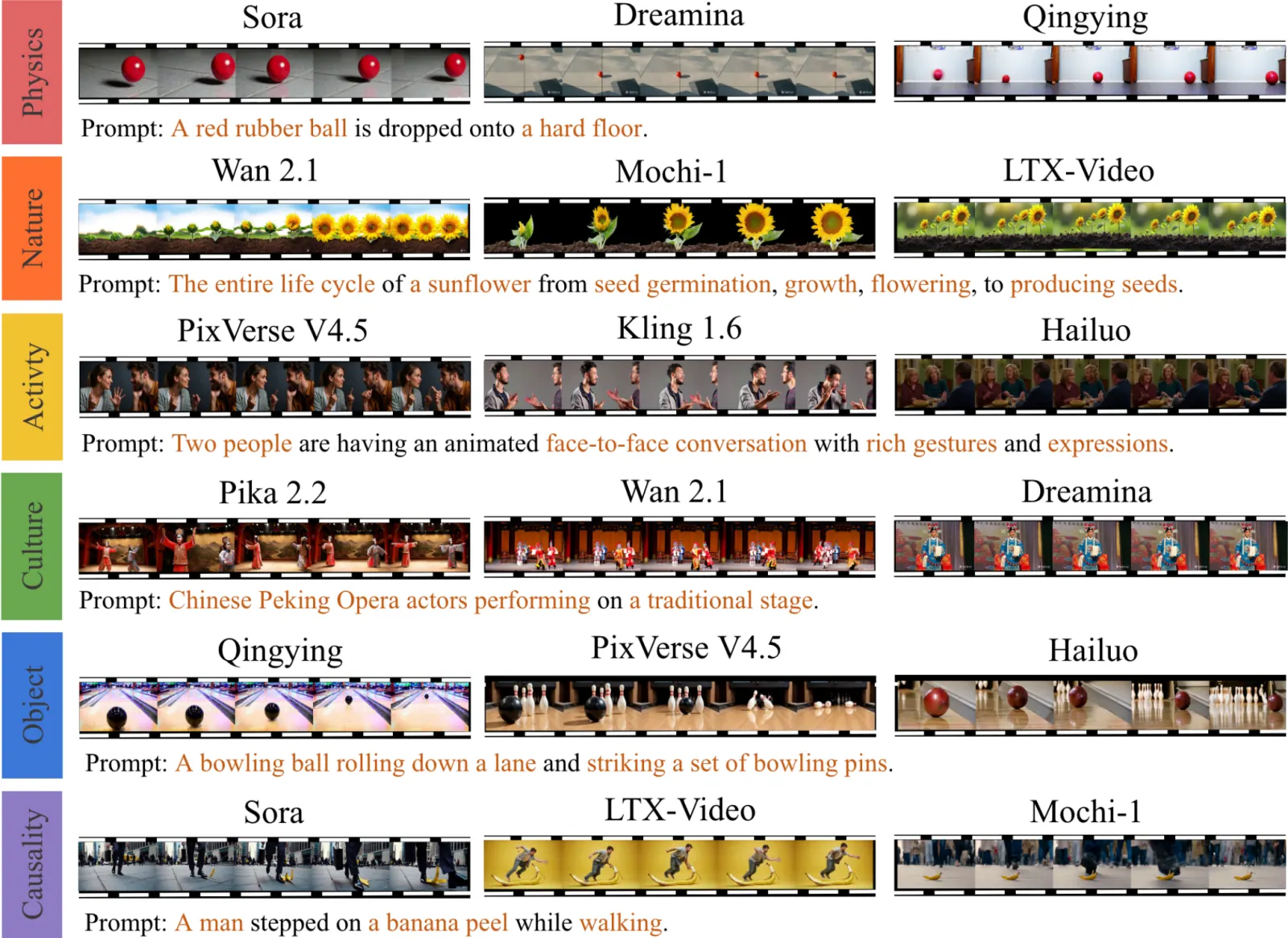
Dimensions
- Physics knowledgeKindCategory
Factual physics generation.
- Nature knowledgeKindCategory
Nature-world knowledge.
- Activity knowledgeKindCategory
Human/activity knowledge.
- Culture knowledgeKindCategory
Cultural facts.
- Causality knowledgeKindCategory
Causal world knowledge.
- Object knowledgeKindCategory
Object-centric world knowledge.
Data composition
- Size
WACV 2026 world-knowledge T2V bench: 6 categories, 60 subcategories, 1,200 prompts. Prompt CSV is vendored; full metadata/sample videos are Drive-hosted.
- Sources
github.com
- Modalities
text · video
- License
unknown_pending_review
- Notes
WorldFoundry normalizes official result fields. Full raw-video/VLM evaluation (LLaVA + Drive assets) is pending.
Metrics
Metric
- DirectionHigher is better
qualityMinimum visual quality score (0–5) in the official CSV.
- DirectionHigher is better
realismMinimum realism score (0–5) in the official CSV.
- DirectionHigher is better
relevanceMinimum prompt relevance score (0–5) in the official CSV.
- DirectionHigher is better
consistencyMinimum temporal consistency score (0–5) in the official CSV.
- DirectionHigher is better
finalMinimum total score (0–20) in the official CSV.
PrimaryFinal
Leaderboard
Results from the paper (not a live board; not WorldFoundry-run scores). T2VWorldBench: A Benchmark for Evaluating World Knowledge in Text-to-Video Generation (2025).
| Model | Average |
|---|---|
| Wan2.1 | 0.68 |
| LTX Video | 0.68 |
| Kling1.6 | 0.67 |
| Dreamina | 0.67 |
| Mochi-1 | 0.66 |
| Sora | 0.65 |
| Hailuo | 0.63 |
| Pika2.2 | 0.60 |
How to run
worldfoundry-eval zoo benchmark-run \
  --benchmark-id t2vworldbench \
  --mode official-validation \
  --official-results-path <model_video_assessment_scores.csv> \
  --generated-artifact-dir <generated_videos> \
  --output-dir tmp/t2vworldbench/official-validation \
  --json
Default import: WORLDFOUNDRY_T2VWORLDBENCH_RESULTS_PATH. Optional root: WORLDFOUNDRY_T2VWORLDBENCH_ROOT. In-tree prompt: worldfoundry/data/benchmarks/assets/t2vworldbench/prompt/prompt.csv.
In-tree pointers: worldfoundry/data/benchmarks/tasks/external/t2vworldbench.yaml, worldfoundry/evaluation/tasks/execution/runners/t2vworldbench/runtime/t2vworldbench.
Outputs include scorecard.json (primary final) and raw_metric_table.jsonl.