
RoboMME
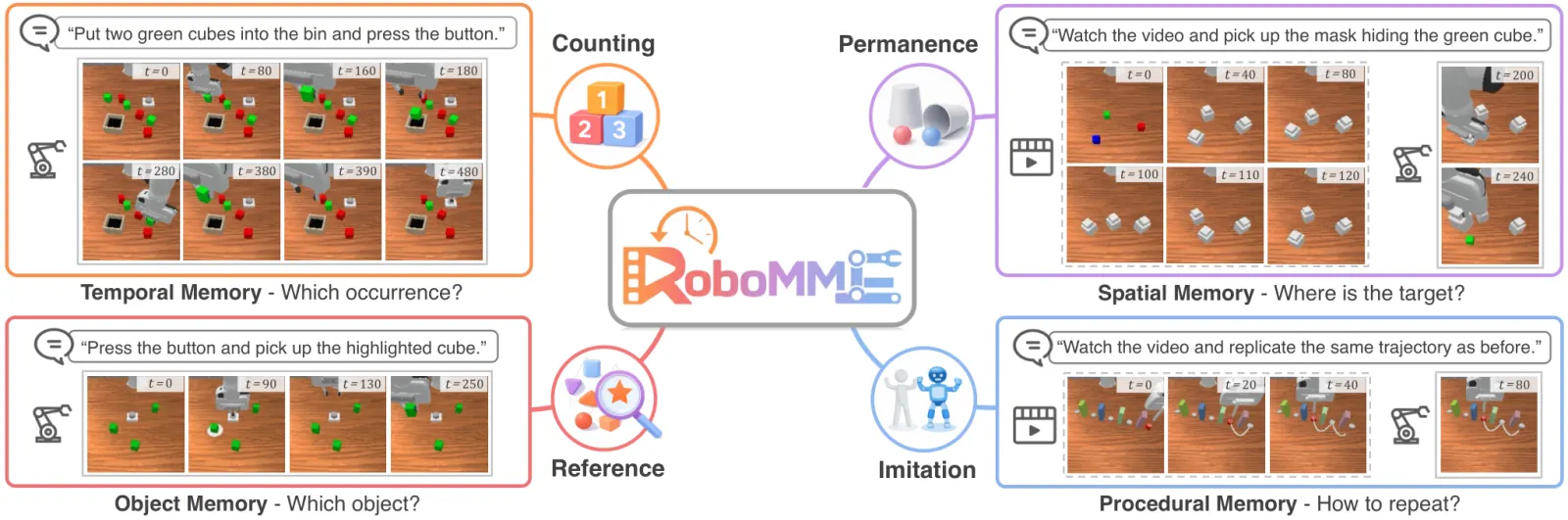
RoboMME (University of Michigan with Stanford and Figure AI; ICML 2026) is a standardized bench for memory-augmented VLAs. 16 long-horizon tasks sit in four cognitive suites — Counting (temporal: exact event counts), Permanence (spatial: occlusion and swaps), Reference (object identity from an earlier cue), Imitation (procedural: copy a demonstrated trajectory) — four tasks each. The release includes 1,600 demonstrations and 770k training timesteps, plus 14 memory-augmented variants on a π0.5 backbone. The paper reports per-suite success, not a single pick-and-place bit.
Paper: RoboMME. Project: robomme.github.io. Code: RoboMME/robomme_policy_learning.
WorldFoundry imports official rollout exports and normalizes overall plus per-suite rates. It does not run the RoboMME simulator or those π0.5 variants. Name the suite (counting / permanence / reference / imitation) on the export.
Dimensions
- CountingKindSuite
Temporal memory: accumulate events and stop after an exact count (four tasks).
- PermanenceKindSuite
Spatial memory: track objects through occlusion and swaps (four tasks).
- ReferenceKindSuite
Object memory: resolve identity from an earlier visual or language cue (four tasks).
- ImitationKindSuite
Procedural memory: reproduce a demonstrated trajectory (four tasks).
Data composition
- Size
ICML 2026 memory-augmented manipulation bench from Michigan, Stanford, and Figure AI. 16 long-horizon tasks (4 suites × 4), 1,600 demonstrations, 770k training timesteps. The paper also releases 14 memory-augmented VLA variants on a π0.5 backbone. Built for history-dependent VLA evaluation, not a single binary pick-and-place bit.
- Sources
github.com
- Splits
counting · imitation · permanence · reference
- Modalities
language · vision · action · state
- License
upstream_terms
- Notes
WorldFoundry normalizes per-suite success from an official export. It does not run the RoboMME simulator or the π0.5 variants.
Metrics
Metric
- DirectionHigher is better
success_rateOverall episode success across imported suites.
PrimarySuccess Rate
- DirectionHigher is better
counting_success_rateSuccess on the Counting suite (temporal memory).
- DirectionHigher is better
permanence_success_rateSuccess on the Permanence suite (spatial memory).
- DirectionHigher is better
reference_success_rateSuccess on the Reference suite (object memory).
- DirectionHigher is better
imitation_success_rateSuccess on the Imitation suite (procedural memory).
Leaderboard
Results from the paper (not a live board; not WorldFoundry-run scores). Paper AVG column. Oracle rows use privileged memory. RoboMME: Benchmarking and Understanding Memory for Robotic Generalist Policies (2026).
| Model | Average success (16 tasks) |
|---|---|
| Human | 90.50 |
| MME-VLA GroundSG Oracleprivileged | 84.08 |
| MME-VLA SimpleSG Oracleprivileged | 49.58 |
| SimpleSG QwenVL | 29.00 |
| Gemini (SimpleSG Oracle setting) | 23.25 |
How to run
worldfoundry-eval zoo benchmark-run \
  --benchmark-id robomme \
  --mode official-validation \
  --official-results-path <official_results.json> \
  --output-dir tmp/robomme/official-validation \
  --json
Optional WORLDFOUNDRY_ROBOMME_ROOT points at a local runtime/repo. Default import path: WORLDFOUNDRY_ROBOMME_RESULTS_PATH. Manifest: worldfoundry/data/benchmarks/tasks/external/robomme.yaml. Outputs: scorecard.json (primary success_rate; also counting_success_rate, permanence_success_rate, reference_success_rate, imitation_success_rate), raw_results.jsonl, evaluation/summary.json.