
VideoScore
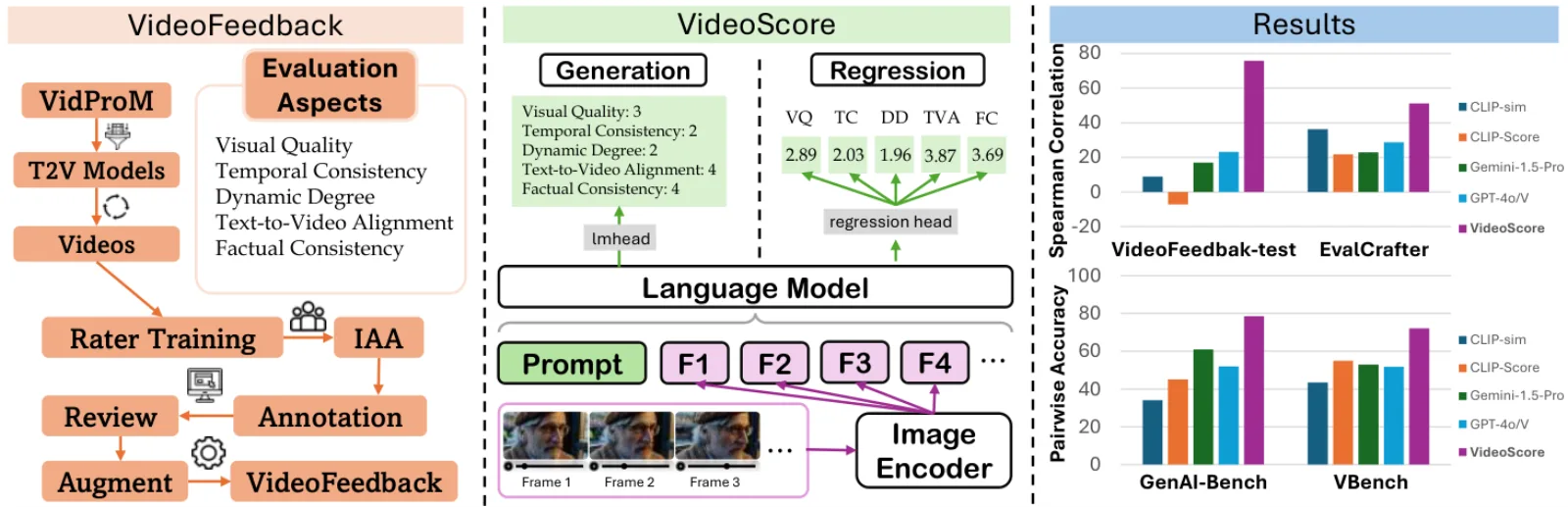
VideoScore (TIGER-Lab, University of Waterloo) is a learned reward model, not a prompt suite. It is trained on VideoFeedback (37.6K human-annotated videos) and predicts five aspect scores (official 1–4 scale) for any generated clip:
- Visual quality
- Temporal consistency
- Dynamic degree
- Text-to-video alignment
- Factual consistency
videoscore_average is the mean of the five. VideoScore-Bench evaluates scorer–human correlation (SPCC / pairwise). License: MIT (runtime); dataset stacks Apache-2.0 / MIT.
Paper: VideoScore. Project: tiger-ai-lab.github.io/VideoScore. Code: TIGER-AI-Lab/VideoScore. Bench data: TIGER-Lab/VideoScore-Bench.
WorldFoundry vendors the runtime, supports bounded in-process GPU scoring, and wraps benchmark/eval_videoscore.py. A bounded official scorer GPU run is verified; SPCC / pairwise full-suite parity is not.
Dimensions
- Five-aspect reward modelKindAxis
Visual quality, temporal consistency, dynamic degree, T2V alignment, factual consistency on a 1–4 scale.
- VideoScore-BenchKindSuite
Scorer–human correlation (SPCC / pairwise) over VideoFeedback-style rows.
Data composition
- Size
TIGER-Lab learned reward model trained on VideoFeedback (37.6K human-annotated videos). Not a prompt suite. MIT runtime; dataset stacks Apache-2.0/MIT.
- Sources
TIGER-Lab/VideoFeedback · TIGER-Lab/VideoScore-Bench · github.com
- License
MIT
- Notes
A bounded official scorer GPU run is verified. SPCC/pairwise full-suite parity is not.
Metrics
Metric
- DirectionHigher is better
visual_qualityVideoScore visual quality aspect score on a 1-4 scale.
- DirectionHigher is better
temporal_consistencyVideoScore temporal consistency aspect score on a 1-4 scale.
- DirectionHigher is better
dynamic_degreeVideoScore dynamic-degree aspect score on a 1-4 scale.
- DirectionHigher is better
text_to_video_alignmentVideoScore text-to-video alignment aspect score on a 1-4 scale.
- DirectionHigher is better
factual_consistencyVideoScore factual consistency aspect score on a 1-4 scale.
- DirectionHigher is better
videoscore_averageMean of the five VideoScore aspect scores.
PrimaryVideoScore Average
Leaderboard
Results from the paper (not a live board; not WorldFoundry-run scores). Judge–human correlation from the paper, not a generator quality board. VideoScore: Building Automatic Metrics to Simulate Fine-grained Human Feedback for Video Generation (2024).
| Model | Spearman average (×100) |
|---|---|
| VideoScore (gen)paper method | 77.1 |
| VideoScore (reg)paper method | 75.7 |
| GPT-4o | 23.0 |
| Gemini-1.5-Flash | 20.8 |
| Gemini-1.5-Pro | 16.9 |
How to run
hf download TIGER-Lab/VideoScore-Bench --repo-type dataset --local-dir /path/to/VideoScore-Bench
export WORLDFOUNDRY_VIDEOFEEDBACK_DATASET_ROOT=/path/to/VideoScore-Bench

${WORLDFOUNDRY_UNIFIED_PYTHON} \
  worldfoundry/evaluation/tasks/execution/runners/videoscore/run_videoscore_official_runner.py \
  --bench-name video_feedback \
  --bounded-sample-count 4 \
  --dataset-root "${WORLDFOUNDRY_VIDEOFEEDBACK_DATASET_ROOT}" \
  --output-dir tmp/videoscore/bounded \
  --json
Import upstream eval_*_videoscore.json via --official-results-path / --from-upstream-results. Env: WORLDFOUNDRY_VIDEOSCORE_MODEL_DIR, WORLDFOUNDRY_VIDEOSCORE_FRAMES_DIR, WORLDFOUNDRY_VIDEOSCORE_ROOT. Shared stack: videoscore_reward_metric_stack.
In-tree pointers: worldfoundry/data/benchmarks/tasks/external/videoscore.yaml, worldfoundry/evaluation/tasks/execution/runners/videoscore/runtime/videoscore.
Outputs include scorecard.json (primary videoscore_average).