
LIBERO-Mem
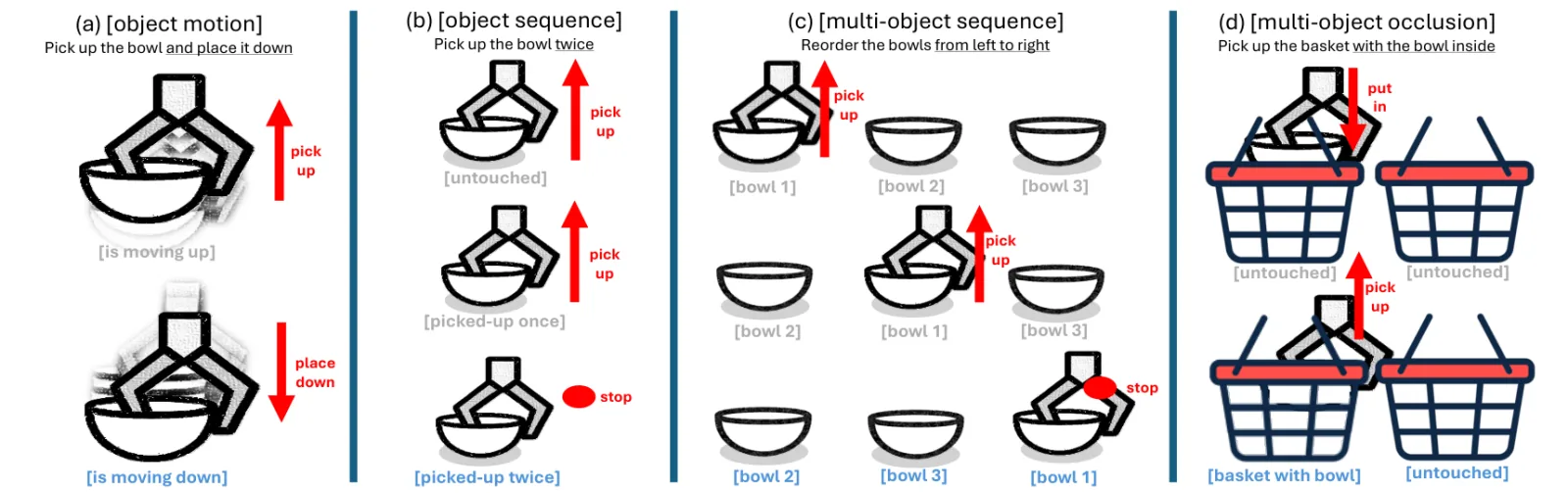
LIBERO-Mem (AAAI 2026) is not the Spatial / Object / Goal / LIBERO-100 lifelong suites. FPT Software AI Center (with Arkansas, Stuttgart, CMU, Aalborg, and Liverpool) added 10 new tabletop tasks on the LIBERO / robosuite stack so a policy cannot succeed from the current frame. Cues live in object history: what moved, how many times, in what order, or behind an occlusion. The four official memory axes:
- Object Motion (OM) — recall the last pick / place on an aliased scene.
- Object Sequence (OS) — count repeated pick-and-place (3× / 5× / 7×).
- Object Relations (OR) — swap or rotate identical bowls across plates.
- Object Occlusion (OO) — remember which basket hid which object.
Each task ships 120 trajectories (100 train / 20 val), 200–700 frames, instance IDs, masks, and symbolic subgoals (→, ∨). Official scoring reports task success and subgoal completion. Embodied-SlotSSM is the authors' companion VLA — a model-card fact, not a WorldFoundry board row.
Paper: Rethinking Progression of Memory State in Robotic Manipulation. Project: libero-mem.github.io. Code: libero-mem/libero-mem.
WorldFoundry is official-results only. You run the upstream evaluator, then official-validation normalizes JSON/CSV into the scorecard. No in-tree simulator, no Embodied-SlotSSM weights. That is different from base LIBERO, which can also wire closed-loop execution.
Dimensions
- Object Motion (OM)KindAxis
Recall the last pick or place when the current frame is aliased.
- Object Sequence (OS)KindAxis
Count repeated pick-and-place (3× / 5× / 7×) that vision alone cannot disambiguate.
- Object Relations (OR)KindAxis
Track temporal order when swapping or rotating identical bowls across plates.
- Object Occlusion (OO)KindAxis
Remember which basket hid which object after it leaves the view.
Data composition
- Size
10 new non-Markovian tabletop tasks on the LIBERO / robosuite stack (not Spatial / Object / Goal / 100). Each task: 120 trajectories (100 train / 20 val), 200–700 frames, object IDs, masks, and symbolic subgoals.
- Sources
github.com
- Splits
om · os · or · oo
- Modalities
language · vision · action · state
- License
upstream_terms
- Notes
Official protocol also reports subgoal completion with Sequence (→) and Or (∨). WorldFoundry imports whatever the official export contains; it does not recompute subgoals.
Metrics
Metric
- DirectionHigher is better
success_rateFull-instruction episode success imported from the official evaluator.
PrimarySuccess Rate
- DirectionHigher is better
memory_success_rateSuccess restricted to memory-critical instances when the export exposes that split.
- DirectionHigher is better
task_successPer-task success among the 10 OM/OS/OR/OO tasks.
- DirectionHigher is better
action_accuracyOffline action-prediction accuracy if the official dump includes it.
Leaderboard
Results from the paper (not a live board; not WorldFoundry-run scores). Official LIBERO-Mem long-horizon suite from the paper. Rethinking Progression of Memory State in Robotic Manipulation: An Object-Centric Perspective (2025).
| Model | T1–T10 average success |
|---|---|
| Naive SlotSSM | 14.8% |
| π0 (h=1) | 5.0% |
| SlotVLA (h=8) | 5.0% |
| SlotVLA (h=1) | 0% |
How to run
worldfoundry-eval zoo benchmark-run \
  --benchmark-id libero-mem \
  --mode official-validation \
  --official-results-path <official_results.json> \
  --output-dir tmp/libero-mem/official-validation \
  --json
Optional WORLDFOUNDRY_LIBERO_MEM_ROOT points at a local toolkit / repo root. Default import path when you omit --official-results-path is WORLDFOUNDRY_LIBERO_MEM_RESULTS_PATH. Manifest: worldfoundry/data/benchmarks/tasks/external/libero-mem.yaml. Outputs: scorecard.json (primary success_rate; also memory_success_rate when the export has it), raw_results.jsonl, and evaluation/summary.json.