
MIND
On this page
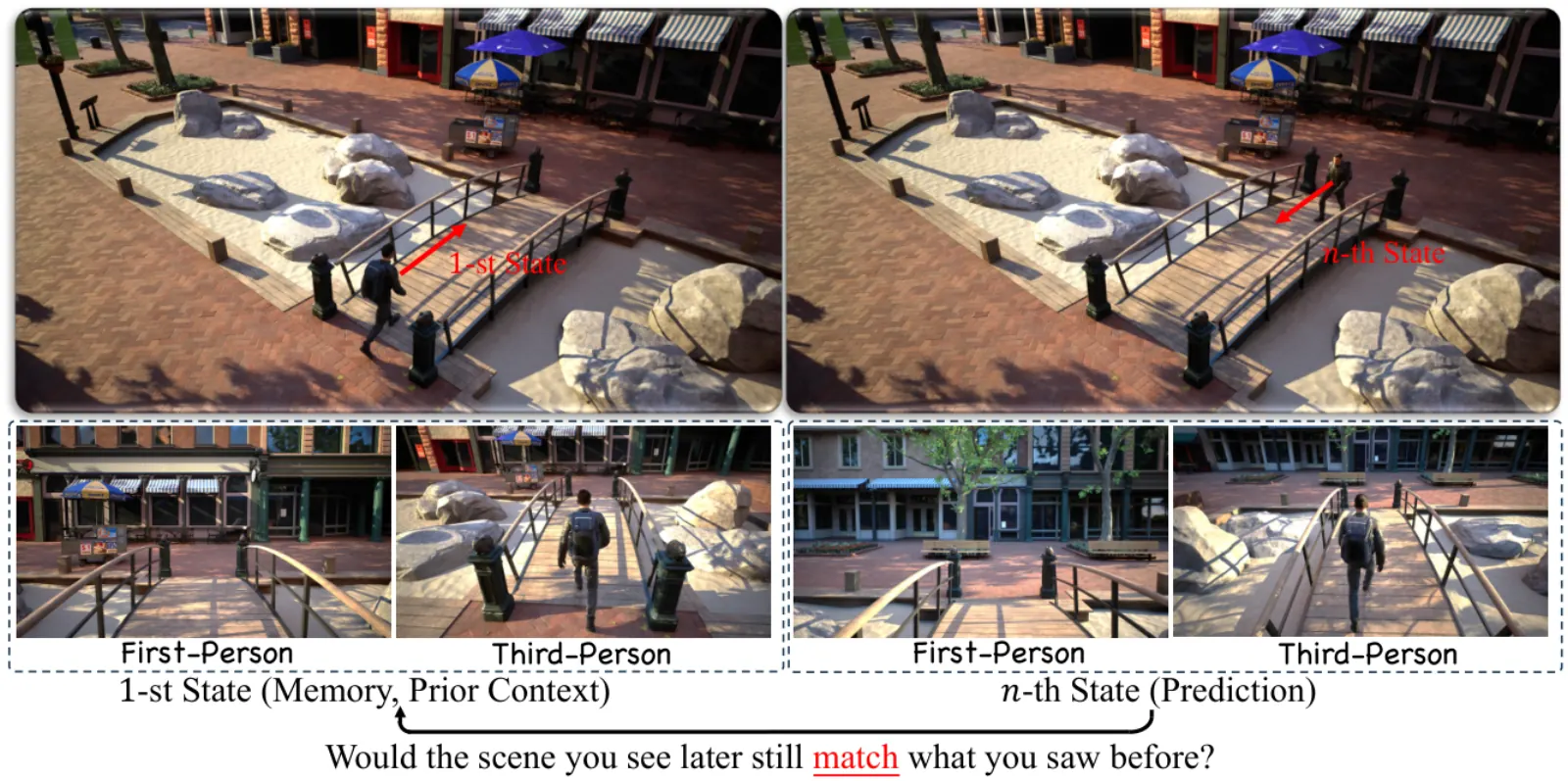
MIND (CSU-JPG) is an open-domain closed-loop revisit bench: the model rolls out under camera / action commands, leaves a region, and returns. Official MIND-Data is 250 Unreal Engine 5 clips at 1080p / 24 FPS across eight scene categories (40+ environments). 200 clips share one action space (100 first-person + 100 third-person); 50 use varied speeds and rotation angles (25 + 25). Scoring: long-context memory (PSNR / SSIM / LPIPS / MSE + DINOv3 patch MSE), visual quality (MUSIQ-SPAQ, LAION aesthetic), action control (ViPE relative pose error), and a mirror test for general scene consistency. Layout: <model>/{1st,3rd}_data/<test_type>/<name>/video.mp4. The project marks a public leaderboard as coming soon.
Paper: MIND. Project: csu-jpg.github.io/MIND.github.io. Code: CSU-JPG/MIND (MIT). Dataset: CSU-JPG/MIND.
WorldFoundry vendors the metric runtime (run_mind_official_runner.py). --run-official scores staged GT + generated videos; --official-results-path imports a finished MIND JSON; --run-fixture is a GPU-free normalizer check. This page does not run world-model inference. mind_average (and the four ability-group scores) are WorldFoundry-derived — MIND publishes no official composite.
Dimensions
- Long-context memoryKindAxis
Leave a region and return. Score the continuation against GT with PSNR / SSIM / LPIPS / MSE plus DINOv3 patch-token MSE.
- Visual qualityKindAxis
MUSIQ-SPAQ imaging quality (/100 upstream) and LAION CLIP ViT-L/14 aesthetic (/10 upstream).
- Action control (ViPE)KindAxis
Relative pose error between ViPE trajectories of generated vs GT video. Needs a ViPE checkout.
- Mirror-test scene consistencyKindAxis
Play a rollout and its time-reversed half (GSC PSNR / SSIM / LPIPS / MSE).
- 1st / 3rd person × action spaceKindSplit
100+100 clips share one action space; 25+25 use varied speeds/angles. Layout: <model>/{1st,3rd}_data/<test_type>/…
Data composition
- Size
CSU-JPG open-domain closed-loop revisit bench. 250 Unreal Engine 5 clips at 1080p / 24 FPS across eight scene categories (natural, urban, indoor, vehicle, sci-fi, stylized, fantasy, abstract; 40+ environments). Shared action space: 100 first-person + 100 third-person. Varied action spaces: 25 + 25. Hugging Face: CSU-JPG/MIND. Official leaderboard is marked coming soon.
- Sources
CSU-JPG/MIND · github.com
- Splits
standard
- Modalities
video · action
- License
MIT
- Notes
WorldFoundry vendors the metric runtime and scores generated videos. It does not generate those videos. mind_average is a WorldFoundry aggregate — MIND publishes no official composite.
Metrics
Metric
- DirectionHigher is better
lcm_psnrLong-context-memory PSNR between the predicted continuation and the ground-truth frames.
- DirectionHigher is better
lcm_ssimLong-context-memory SSIM against the ground-truth continuation.
- DirectionLower is better
lcm_lpipsLong-context-memory LPIPS (AlexNet) against the ground-truth continuation; lower is better.
- DirectionLower is better
lcm_mseLong-context-memory pixel MSE against the ground-truth continuation; lower is better.
- DirectionLower is better
dino_mseMSE between L2-normalized DINOv3 patch tokens of predicted and ground-truth frames; lower is better.
- DirectionHigher is better
imaging_qualityMUSIQ-SPAQ imaging quality of the generated frames, divided by 100 upstream.
- DirectionHigher is better
aesthetic_qualityLAION CLIP ViT-L/14 aesthetic predictor score, divided by 10 upstream.
- DirectionLower is better
action_rpe_trans_meanMean translation relative pose error between the ViPE trajectories of generated and ground-truth videos; lower is better.
- DirectionLower is better
action_rpe_rot_mean_degMean rotation relative pose error in degrees between the ViPE trajectories; lower is better.
- DirectionLower is better
action_rpe_trans_medianMedian translation relative pose error over all valid action steps; lower is better.
- DirectionLower is better
action_rpe_rot_median_degMedian rotation relative pose error in degrees over all valid action steps; lower is better.
- DirectionLower is better
action_translation_rpe_trans_meanMean translation RPE restricted to pure translation actions; lower is better.
- DirectionLower is better
action_rotation_rpe_rot_mean_degMean rotation RPE in degrees restricted to pure camera-rotation actions; lower is better.
- DirectionHigher is better
gsc_psnrGeneral scene consistency PSNR between a mirror-test rollout and its time-reversed half.
- DirectionHigher is better
gsc_ssimGeneral scene consistency SSIM on the mirror-test rollout.
- DirectionLower is better
gsc_lpipsGeneral scene consistency LPIPS on the mirror-test rollout; lower is better.
- DirectionLower is better
gsc_mseGeneral scene consistency pixel MSE on the mirror-test rollout; lower is better.
- DirectionHigher is better
memory_consistency_scoreWorldFoundry-derived mean of the normalized LCM and DINOv3 component metrics.
- DirectionHigher is better
visual_quality_scoreWorldFoundry-derived mean of the normalized imaging and aesthetic metrics.
- DirectionHigher is better
action_control_scoreWorldFoundry-derived mean of the normalized overall RPE translation and rotation metrics.
- DirectionHigher is better
scene_consistency_scoreWorldFoundry-derived mean of the normalized mirror-test GSC metrics.
- DirectionHigher is better
mind_averageWorldFoundry-derived mean of the available MIND ability-group scores. MIND publishes no official composite score, so this is never a leaderboard number.
PrimaryMIND Average
Leaderboard
Results from the paper (not a live board; not WorldFoundry-run scores). Table 2 first-person split. Lower MSE is better. The project page still marks a public live board as coming soon. MIND: Benchmarking Memory Consistency and Action Control in World Models (2026).
| Model | Long context memory (↓, MIND-First 50) |
|---|---|
| MIND-Worldvideo-to-world | 0.1035 |
| MIND-Worldimage-to-world | 0.1091 |
| Matrix-Game 2.0image-to-world | 0.1188 |
How to run
GPU-free fixture:
python worldfoundry/evaluation/tasks/execution/runners/mind/run_mind_official_runner.py \
  --run-fixture \
  --output-dir tmp/mind/fixture \
  --json
Score staged GT and model outputs (DINOv3 via --dino-path; ViPE via --vipe-repo when you want action metrics):
${WORLDFOUNDRY_UNIFIED_PYTHON} \
  worldfoundry/evaluation/tasks/execution/runners/mind/run_mind_official_runner.py \
  --run-official \
  --gt-root /path/to/MIND-Data \
  --generated-artifact-dir "${WORLDFOUNDRY_GENERATED_ARTIFACT_DIR}" \
  --dino-path /path/to/dinov3_vitb16 \
  --output-dir tmp/mind/official \
  --json
Import a finished MIND result JSON:
worldfoundry-eval zoo benchmark-run \
  --benchmark-id mind \
  --mode official-validation \
  --official-results-path <mind_result.json> \
  --output-dir tmp/mind/official-validation \
  --json
--metrics is a comma list (lcm,visual,dino,action,gsc; default all). --video-max-time caps frames for every metric except action. DINOv3 weights default to ./dinov3_vitb16 unless --dino-path / WORLDFOUNDRY_MIND_DINO_PATH. Extra pip pins for the metric stack are in worldfoundry/data/benchmarks/requirements/mind.txt. Action scoring also needs a ViPE checkout (--vipe-repo).
The vendored src/process.py can fan work across GPUs: videos go on a queue, each GPU takes one task, failures go back on the queue, and the result JSON is rewritten after every finished task so you can read a partial file. WorldFoundry --run-official is the supported entry; do not treat src/process.py as a second public CLI.
Mutable state (work dir, MIND_CACHE_DIR, logs) stays under --output-dir. Env: WORLDFOUNDRY_MIND_ROOT, WORLDFOUNDRY_MIND_RESULTS_PATH, WORLDFOUNDRY_GENERATED_ARTIFACT_DIR. Manifest: worldfoundry/data/benchmarks/tasks/external/mind.yaml. Outputs: scorecard.json (primary mind_average), raw_metric_table.jsonl, per_sample_scores.jsonl, benchmark_contract.json.
Generated-video and GT layouts
--generated-artifact-dir must mirror perspectives and test types. {corresponding data name} is the GT folder name. Mirror tests use ten path videos instead of one video.mp4:
{model_name}/
  1st_data/
    action_space_test/{name}/video.mp4
    mem_test/{name}/video.mp4
    mirror_test/{any_name}/path-1.mp4 … path-10.mp4
  3rd_data/
    action_space_test/{name}/video.mp4
    mem_test/{name}/video.mp4
    mirror_test/{any_name}/path-1.mp4 … path-10.mp4
Official MIND-Data (train + test) looks like:
MIND-Data/
  1st_data/
    test/action_space_test/{gt}/action.json + images.txt + video.mp4
    test/mem_test/{gt}/action.json + images.txt + video.mp4
    train/{gt}/action.json + video.mp4
  3rd_data/
    …same test / train split…
action.json fields:
mark_time— first frame of the expected prediction (memory / context divider).total_time— GT frame count.caption— text description.data[*].timeplusws/ad/ud/lraction codes (0none;1/2the two directions).actor_pos/actor_rpy; third-person clips also havecamera_pos/camera_rpy.
Official Result.json
--official-results-path and --run-official both produce the official document. Top level has video_max_time and data[]. Each row has path, perspective (1st_data / 3rd_data), test_type (mem_test / action_space_test / mirror_test), optional error, mark_time, total_time, sample_frames, then metric blocks:
lcm— per-frame andavg_*for MSE / LPIPS / SSIM / PSNR.visual_quality— per-frameimaging(MUSIQ-SPAQ) andaesthetic(LAION) plus averages.dino— per-framedino_mseandavg_dino_mse.action— ViPE RPE after outlier filtering:__overall__,translation,rotation,other, andact:<name>(rpe_trans_mean/median,rpe_rot_mean_deg/median_deg,count).video_results[*].gsc— mirror-test general scene consistency (same four pixel metrics;sample_framesshould be2 × mark_time).
The bundled fixture at worldfoundry/data/benchmarks/assets/mind/fixtures/mind_result_fixture.json follows this schema with invented numbers. It contains no upstream MIND records — every sample id, frame count, and score was written so normalization, aggregation, and scorecard invariants can run without GPUs, ViPE, or the official dataset. Do not publish it as a MIND score.