
STEVO-Bench
On this page
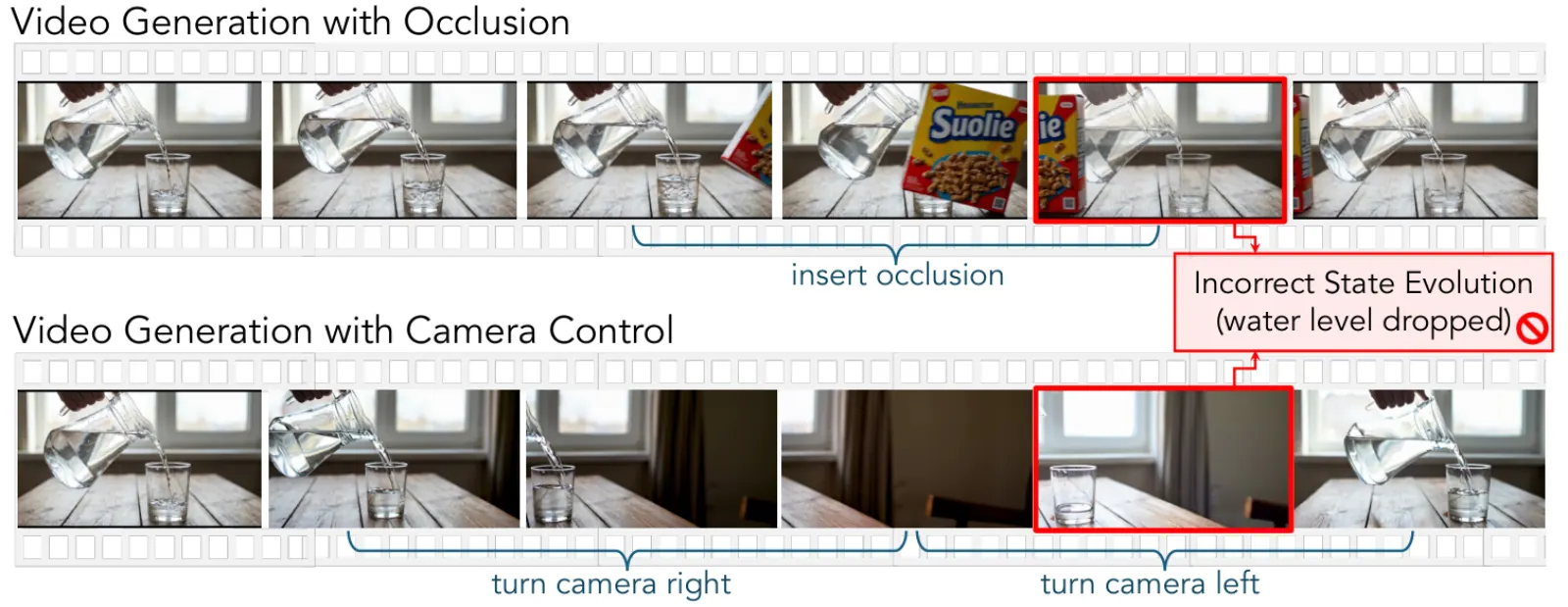
STEVO-Bench (Caltech GLab) asks whether a video world model keeps simulating state while it is unobserved. Each task applies an observation control (in-scene occlusion, camera lookaway, or illumination dimming) plus a trigger action. VLM judges check that the hidden process kept progressing and stayed physically plausible. Official size: 225 tasks across 6 world-change categories. License: MIT (retained in the vendored tree, pin 680fb6ee2733…).
Three executable criteria (pinned eval/eval_cli.py): control (occlusion_done, trigger_applied), physics (physical_inaccuracy), state (state_evol). The pinned CLI does not define --artifact or --coherence. Aggregation matches eval/summarize_results.py: control_success = occlusion_done AND trigger_applied, task_success = state_evol AND NOT physical_inaccuracy (primary).
Paper: STEVO-Bench. Site: glab-caltech.github.io/STEVOBench. Tasks: JhanLiufu/StEvo-Bench. Upstream: jhanliufu-personal/STEVO-Bench.
WorldFoundry vendors the official judge code. Judges are remote VLM APIs (Gemini by default; GOOGLE_API_KEY). Paper config: --ensemble-size 3. --run-fixture is a synthetic normalizer sample only.
worldfoundry/data/benchmarks/assets/stevo-bench/sample_run/ mirrors the official evaluator layout (eval/eval_cli.py plus eval/summarize_results.py at the pinned revision): summary.json plus per_task/<task_id>/se_report__<provider>__<model>.json. It has no upstream tasks, prompts, videos, or real judge outputs. The real 225-task suite is JhanLiufu/StEvo-Bench; real verdicts come from hosted VLM APIs during --run-official. per_task/candle_burn_01/ deliberately carries a verdict that is missing from summary.json so the report-merge path stays covered.
Dimensions
- ControlKindTrack
occlusion_done and trigger_applied. control_success is both.
- PhysicsKindTrack
physical_inaccuracy; lower is better.
- State evolutionKindTrack
state_evol: hidden process kept progressing. Primary task_success = state_evol AND NOT physical_inaccuracy.
Data composition
- Size
Caltech GLab state-evolution-out-of-sight bench. 225 tasks across 6 world-change categories. Official judges are remote VLMs (Gemini default, ensemble size 3). MIT.
- Sources
JhanLiufu/StEvo-Bench · github.com
- Modalities
image · video · text
- License
MIT
- Notes
WorldFoundry vendors the official evaluator (pin 680fb6ee2733…). leaderboard_valid stays false until the full 225-task official ensemble is judged. No offline judge.
Metrics
Metric
- DirectionHigher is better
task_successPrimary metric: fraction of tasks with confirmed state evolution and no physical inaccuracy (state_evol AND NOT physical_inaccuracy).
PrimaryTask Success
- DirectionHigher is better
state_evol_successFraction of tasks where the state-evolution judge confirmed the hidden process kept progressing while unobserved.
- DirectionLower is better
physical_inaccuracyFraction of tasks flagged physically implausible by the physics judge; lower is better and the normalized score is 1 - rate.
- DirectionHigher is better
occlusion_doneFraction of tasks where the requested observation control (occlusion, camera lookaway, or illumination dimming) was applied in the generated video.
- DirectionHigher is better
trigger_appliedFraction of tasks where the requested trigger action was applied in the generated video.
- DirectionHigher is better
control_successFraction of tasks where the observation control and the trigger action were both applied.
Leaderboard
Results from the paper (not a live board; not WorldFoundry-run scores). Paper Success column for video models. Out of Sight, Out of Mind? Evaluating State Evolution in Video World Models (2026).
| Model | Success |
|---|---|
| Veo 3 | 8.7 |
| Sora 2 Pro | 8.1 |
| WAN 2.2 | 0.9 |
| HY-Video 1.5 | 0.9 |
| CogVideoX 1.5 | 0.5 |
How to run
hf download JhanLiufu/StEvo-Bench --repo-type dataset --local-dir /path/to/stevo-bench-tasks
export WORLDFOUNDRY_STEVO_BENCH_TASK_ROOT=/path/to/stevo-bench-tasks
export WORLDFOUNDRY_STEVO_BENCH_VLM_PROVIDER=gemini
export GOOGLE_API_KEY=<your-key>

${WORLDFOUNDRY_UNIFIED_PYTHON} \
  worldfoundry/evaluation/tasks/execution/runners/stevo_bench/run_stevo_bench_official_runner.py \
  --run-official \
  --generated-artifact-dir /path/to/generated \
  --task-root "${WORLDFOUNDRY_STEVO_BENCH_TASK_ROOT}" \
  --criterion all \
  --ensemble-size 3 \
  --workers 5 \
  --summarize \
  --output-dir tmp/stevo_bench/official-run \
  --json
Import summary.json, a run directory, a runs/ parent, or a bare per_task/ tree without an API key:
worldfoundry-eval zoo benchmark-run \
  --benchmark-id stevo-bench \
  --mode official-validation \
  --official-results-path /path/to/runs/<output_map_stem> \
  --output-dir tmp/stevo_bench/imported \
  --json
Pass --output-map when stems are ambiguous. Filename-derived maps, sub-3 ensembles, and partial coverage are recorded as comparability blockers.
Generated videos should sit in one directory as <task_id>.mp4 plus exactly one output_map.json that maps each task YAML id to a filename relative to that directory. Extra vendor Python deps (judge APIs, OpenCV) live in worldfoundry/data/benchmarks/requirements/stevo-bench.txt; the cross-model ensemble extras are in worldfoundry/data/benchmarks/requirements/stevo-bench-eval-se.txt.
In-tree pointers: worldfoundry/data/benchmarks/tasks/external/stevo-bench.yaml, worldfoundry/evaluation/tasks/execution/runners/stevo_bench/runtime/stevo_bench.
Outputs include scorecard.json (primary task_success) with leaderboard_blockers / comparability_blockers.
Generation layout and official run tree
outputs/my_model_my_run/
  task_id_1.mp4
  task_id_2.mp4
  …
  output_map.json          ← exactly one JSON file
{
"task_id_1": "task_id_1.mp4",
"task_id_2": "task_id_2.mp4"
}Task ids must match the id field in the task YAML under --task-root. The official runner calls vendored eval.eval_cli (paper ensemble --ensemble-size 3, majority). Do not use deleted vendor shells (run_eval.sh) or the older --artifact / --coherence flags — they are not on the pinned CLI.
A finished official run directory looks like:
runs/<output_map_stem>/
  summary.json
  per_task/<task_id>/
    control_report.json
    physics report (physical_inaccuracy)
    se_report.json
--summarize refreshes summary.json the same way as eval.summarize_results. --official-results-path can point at that run dir, its parent runs/, summary.json, or a bare per_task/ tree.
The vendored tree also has a generation helper (generation.run_world_models) that writes outputs/{model}_{run_name}/ plus an output map. Models register in generation/configs/models.yaml as type: api (Veo / Sora adapters, prompt_field, api_key_env, RPM / timeout) or type: local (wrapper run_single.sh with --prompt, --output, optional --init_frame / --camera_control; large models can add daemon_script + --tasks_json). WorldFoundry generation still goes through integrated WorldFoundry models; that helper is optional vendor tooling.
Optional eval_se research scripts
runtime/stevo_bench/eval/eval_se/ is a separate Gemini two-step probe (predict the hidden process from the first frame + action, then verify the video). It is not the official three-criterion CLI.
- Standard / evidence / ensemble prompts (
gemini_evaluator.py,gemini_evaluator_evidence.py,gemini_evaluator_ensemble.py). Evidence was the best single judge in their tests;--ensembledoes 3 calls per task (~3× cost). - Cross-model Gemini+GPT unanimous voting:
gemini_gpt_evaluator.py(installworldfoundry/data/benchmarks/requirements/stevo-bench-eval-se.txt). - Default filter in those scripts: level-4 tasks whose id does not end in
_00, with initial image + video + YAML present.
Use them only for analysis. Reportable WorldFoundry scores come from run_stevo_bench_official_runner.py / worldfoundry-eval zoo benchmark-run --benchmark-id stevo-bench.