
Physical AI Bench (PAI-Bench)
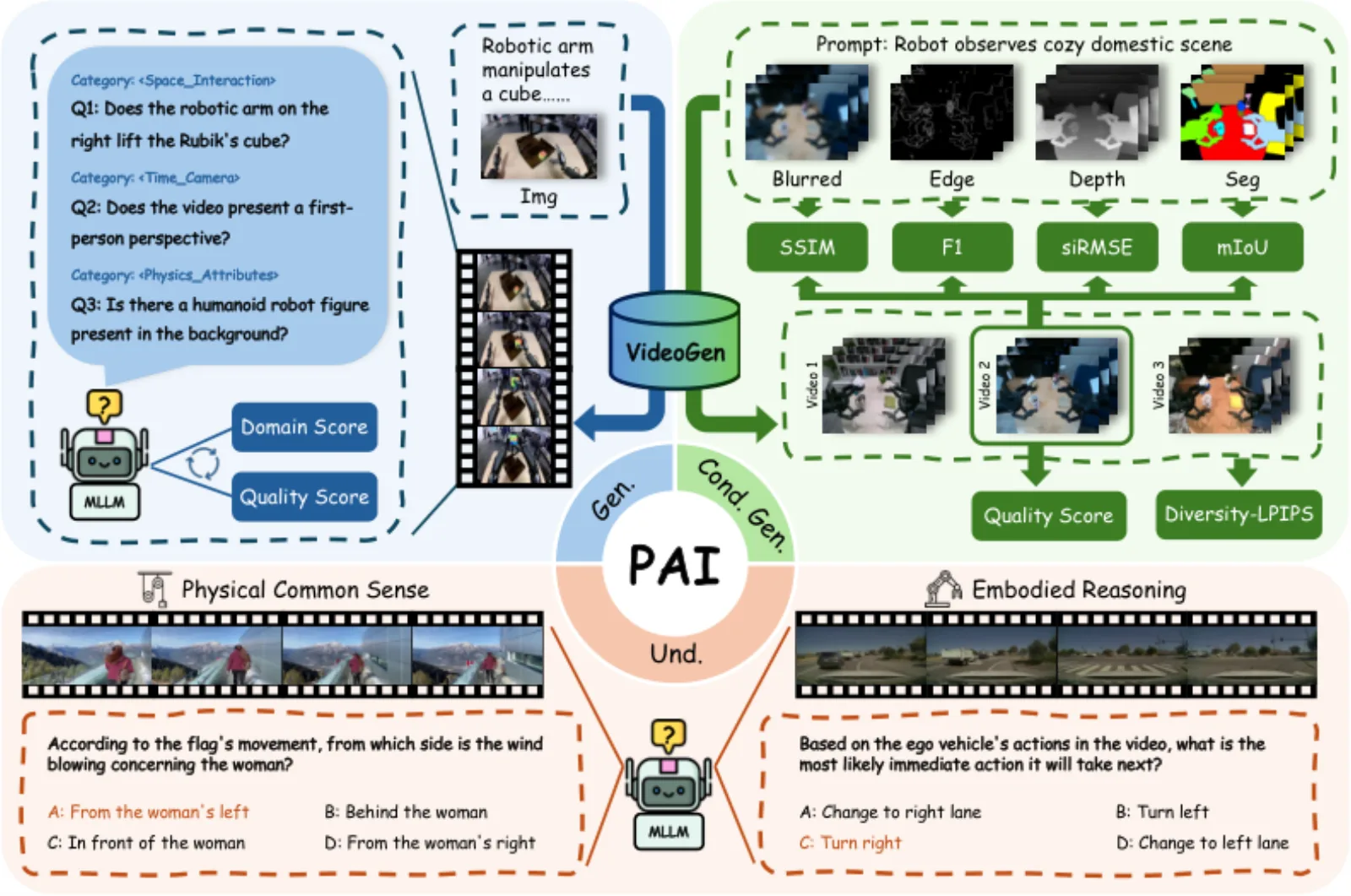
PAI-Bench (SHI Labs / Georgia Tech, with CMU and NVIDIA Research; CVPR 2026) is a multi-track Physical AI suite: perception and control fidelity on generated video, not a physics-law prompt set like PhyGenBench and not a filmed continuation like Physics-IQ.
WorldFoundry's in-tree evaluator implements two tracks only:
- PAI-Bench-G (
--track generation): VBench / VBench++-style perception metrics plus VQA. Dataset:shi-labs/physical-ai-bench-generation. - PAI-Bench-C (
--track conditional-generation): control fidelity (Canny, depth si-RMSE, segmentation, blur SSIM, LPIPS diversity). Dataset:shi-labs/physical-ai-bench-conditional-generation(~273 GB).
The paper may describe additional tracks. Those are not in this contract — do not pass --track understanding. The contract also does not mark a single primary metric; do not treat aesthetic_quality as the official total.
Paper: PAI-Bench. Code: SHI-Labs/physical-ai-bench.
Dimensions
- PAI-Bench-GKindTrack
Video generation track: VBench/VBench++-style perception metrics plus VQA. Needs --generated-video-dir and shi-labs/physical-ai-bench-generation.
- PAI-Bench-CKindTrack
Conditional generation track: control fidelity (Canny, depth, segmentation, blur, LPIPS diversity). Dataset is large (~273 GB).
Data composition
- Size
WorldFoundry's in-tree evaluator covers two tracks only: generation (shi-labs/physical-ai-bench-generation) and conditional-generation (shi-labs/physical-ai-bench-conditional-generation, ~273 GB). The paper may describe additional tracks; those are not in this contract. No official leaderboard is ingested.
- Sources
shi-labs/physical-ai-bench-generation · shi-labs/physical-ai-bench-conditional-generation · github.com
- Splits
generation · conditional-generation
- Modalities
text · image · video
- Notes
The contract does not mark a single primary metric. Generation and conditional-generation expose different families. Local scorecards are not SHI-Labs leaderboard submissions.
Metrics
Metric
- DirectionHigher is better
aesthetic_qualityGeneration-track VBench-style aesthetic quality.
- DirectionHigher is better
background_consistencyGeneration-track VBench-style background consistency.
- DirectionHigher is better
imaging_qualityGeneration-track VBench-style imaging quality.
- DirectionHigher is better
motion_smoothnessGeneration-track VBench-style motion smoothness.
- DirectionHigher is better
overall_consistencyGeneration-track VBench-style text–video consistency.
- DirectionHigher is better
subject_consistencyGeneration-track VBench-style subject identity consistency.
- DirectionHigher is better
i2v_backgroundGeneration-track VBench++ image-to-video background preservation.
- DirectionHigher is better
i2v_subjectGeneration-track VBench++ image-to-video subject preservation.
- DirectionHigher is better
vqa_accuracyGeneration-track judge VQA on physical-plausibility questions.
- DirectionHigher is better
dover_tech_scoreConditional-track DOVER technical quality.
- DirectionHigher is better
blur_ssimConditional-track SSIM vs. blur conditioning.
- DirectionHigher is better
canny_f1_scoreConditional-track F1 of Canny edges vs. the condition.
- DirectionHigher is better
canny_precisionConditional-track Canny precision vs. the condition.
- DirectionHigher is better
canny_recallConditional-track Canny recall vs. the condition.
- DirectionLower is better
depth_si_rmseConditional-track scale-invariant RMSE vs. conditioning depth. Lower is better.
- DirectionHigher is better
seg_m_iouConditional-track mean IoU vs. conditioning segmentation.
- DirectionHigher is better
seg_recallConditional-track recall of the conditioning segmentation.
- DirectionHigher is better
lpips_diversityConditional-track LPIPS diversity across generations from the same condition.
Leaderboard
Results from the paper (not a live board; not WorldFoundry-run scores). PAI-Bench: A Comprehensive Benchmark For Physical AI (2025).
| Model | Overall domain score |
|---|---|
| Veo3proprietary | 82.2 |
| HunyuanVideo-I2V | 77.6 |
| MAGI-1-4.5B | 77.5 |
| LTX-Video-2B | 77.5 |
| DynamicCrafter | 68.3 |
How to run
Score the generation track over staged data and generated videos:
${WORLDFOUNDRY_UNIFIED_PYTHON} \
  worldfoundry/evaluation/tasks/execution/runners/physical_ai_bench/run_physical_ai_bench_official_runner.py \
  --run-official \
  --track generation \
  --dataset-root "${WORLDFOUNDRY_PHYSICAL_AI_BENCH_DATASET_ROOT}" \
  --generated-video-dir "${WORLDFOUNDRY_GENERATED_ARTIFACT_DIR}" \
  --output-dir tmp/physical_ai_bench/generation \
  --json
Conditional track (checkpoints or prediction dirs as needed):
${WORLDFOUNDRY_UNIFIED_PYTHON} \
  -m worldfoundry.evaluation.tasks.execution.runners.physical_ai_bench.run_physical_ai_bench_official_runner \
  --run-official \
  --track conditional-generation \
  --dataset-root "${WORLDFOUNDRY_PHYSICAL_AI_BENCH_DATASET_ROOT}" \
  --generated-video-dir "${WORLDFOUNDRY_GENERATED_ARTIFACT_DIR}" \
  --output-dir tmp/physical_ai_bench/conditional \
  --json
--metrics restricts families for development. Generation VQA needs a prediction manifest or a configured Qwen-compatible judge (--judge-backend, --judge-model, --judge-base-url). Outputs include scorecard.json and official_results.json.
In-tree tracks and sidecars
This integration is inference-only. It never clones or imports the upstream repo or its third_party tree. Prompts, evaluator settings, and provenance live under worldfoundry/data/benchmarks/assets/physical-ai-bench (no SOURCE.json on purpose).
- Generation reuses the checked-in VBench / VBench++ I2V runtimes. Example metric list:
aesthetic_quality,background_consistency,imaging_quality,motion_smoothness,overall_consistency,subject_consistency. Binary physical VQA accepts a prediction manifest or a Qwen video judge. - Conditional-generation implements the published CPU transfer metrics locally and reuses shared DOVER, LPIPS, Video-Depth-Anything, GroundingDINO, and SAM2 base models. Precomputed sidecars:
--pred-depth-dir(.npy) and--pred-segmentation-dir(JSON). Official dataset pickles load only with explicit--allow-trusted-pickle; prefer JSON segmentation sidecars.
Standard profile: worldfoundry-unified-cu128. Result normalization and the CPU Canny / blur / depth / segmentation metrics do not need a second env. Model-backed metrics need the matching WorldFoundry checkpoints.
PAI-Bench-G's Qwen2.5-VL-72B binary-VQA judge usually needs its own multi-GPU server. When it does not fit the unified process, start a vLLM OpenAI-compatible server and pass:
--judge-backend openai-compatible \
--judge-model Qwen/Qwen2.5-VL-72B-Instruct \
--judge-base-url http://localhost:8000/v1
That extra environment is only the optional model server. Benchmark code and aggregation stay in the unified WorldFoundry process.