
VideoPhy
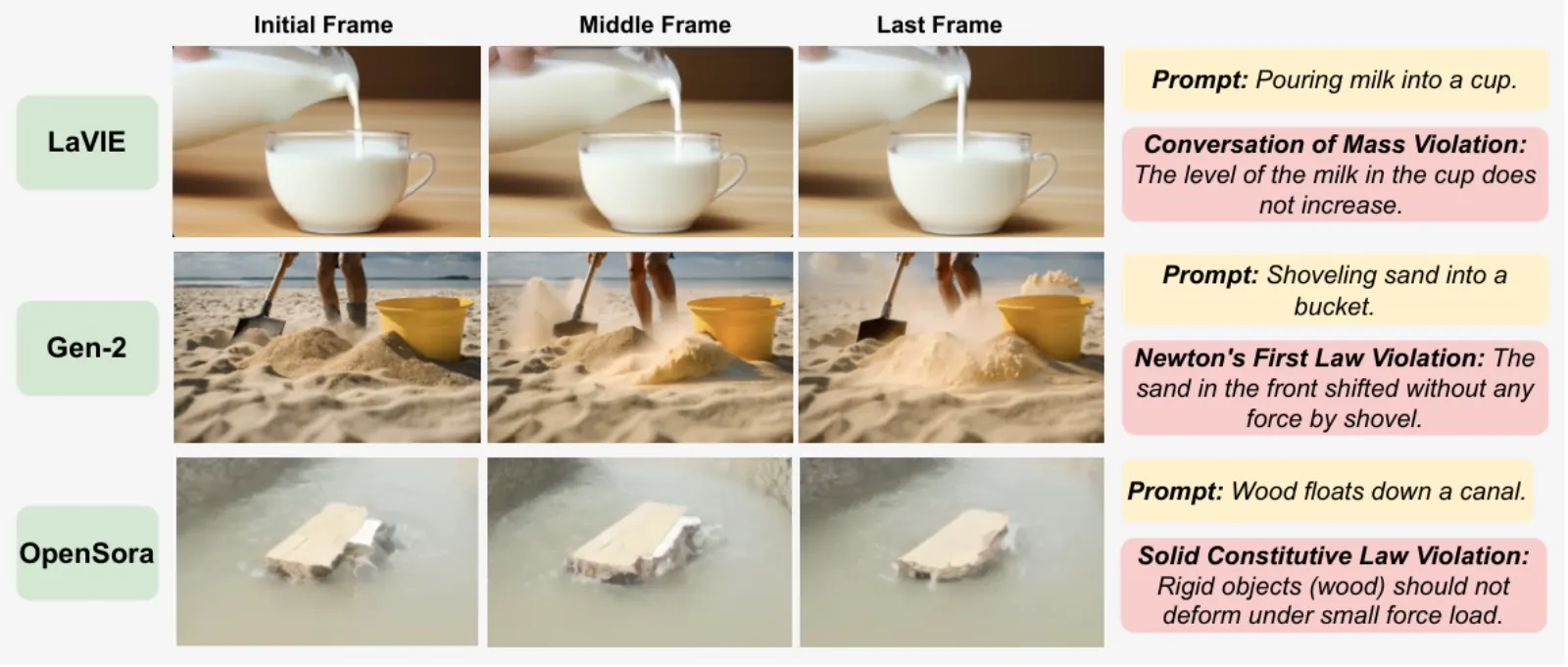
VideoPhy (UCLA and Google Research) tests whether text-to-video models obey physical commonsense in material interactions (solid-solid, solid-fluid, fluid-fluid). Each prompt describes a physical interaction. The official judge is VideoCon-Physics, a fine-tuned video-language model. Three scores:
- Semantic Adherence — does the clip match the prompt?
- Physical Commonsense — does the motion obey physics?
- Joint Score — both together.
videophy_average is the WorldFoundry mean over available families. The official scoring path is in tree; full 688-prompt reproduction is pending.
Paper: VideoPhy. Project: videophy.github.io. Code: Hritikbansal/videophy.
WorldFoundry bundles the prompt list and can run the in-tree VideoCon-Physics AutoEvaluator (--videocon-checkpoint, --sa-threshold / --pc-threshold) or import official JSON. The checkpoint is caller-supplied, not vendored.
Dimensions
- Semantic AdherenceKindAxis
Does the clip match the physical-interaction prompt?
- Physical CommonsenseKindAxis
Does the motion obey physics for solid/fluid interactions?
- Joint ScoreKindAxis
SA and PC together.
Data composition
- Size
UCLA / Google T2V physical-commonsense bench. Official judge: VideoCon-Physics. Full official suite is 688 prompts; in-tree prompt list is bundled. Scoring path present; full reproduction pending.
- Sources
github.com
- Modalities
text · video
- Notes
VideoCon-Physics checkpoint is caller-supplied, not vendored.
Metrics
Metric
- DirectionHigher is better
semantic_adherenceSemantic Adherence normalized benchmark score.
- DirectionHigher is better
physical_commonsensePhysical Commonsense normalized benchmark score.
- DirectionHigher is better
joint_scoreJoint Score normalized benchmark score.
- DirectionHigher is better
videophy_averageVideoPhy Average normalized benchmark score.
PrimaryVideoPhy Average
Leaderboard
Results from the paper (not a live board; not WorldFoundry-run scores). Paper overall semantic-adherence and physical-commonsense joint rate. Later models are on the VideoPhy-2 live board. VideoPhy: Evaluating Physical Commonsense for Video Generation (2024).
| Model | Overall SA, PC (%) |
|---|---|
| CogVideoX-5B | 39.6 |
| Pika | 19.7 |
| VideoCrafter2 | 19.0 |
| CogVideoX-2B | 18.6 |
| LaVIE | 15.7 |
| Dream Machine | 13.6 |
| Lumiere-T2I2V | 12.5 |
| ZeroScope | 11.9 |
How to run
worldfoundry-eval zoo benchmark-run \
  --benchmark-id videophy \
  --mode official-validation \
  --official-results-path <official_results.json> \
  --generated-artifact-dir <generated_videos> \
  --output-dir tmp/videophy/official-validation \
  --json
${WORLDFOUNDRY_UNIFIED_PYTHON} \
worldfoundry/evaluation/tasks/execution/runners/videophy/run_videophy_official_runner.py \
--run-official \
--generated-artifact-dir "${WORLDFOUNDRY_GENERATED_ARTIFACT_DIR}" \
--videocon-checkpoint /path/to/videocon_physics \
--output-dir tmp/videophy/official \
--jsonEnv: WORLDFOUNDRY_VIDEOPHY_RESULTS_PATH, WORLDFOUNDRY_VIDEOPHY_JUDGE_BACKEND. Prompt list: worldfoundry/data/benchmarks/assets/videophy/prompts.json.
In-tree pointers: worldfoundry/data/benchmarks/tasks/external/videophy.yaml, worldfoundry/evaluation/tasks/execution/runners/videophy.
Outputs include scorecard.json (primary videophy_average).