
World-in-World
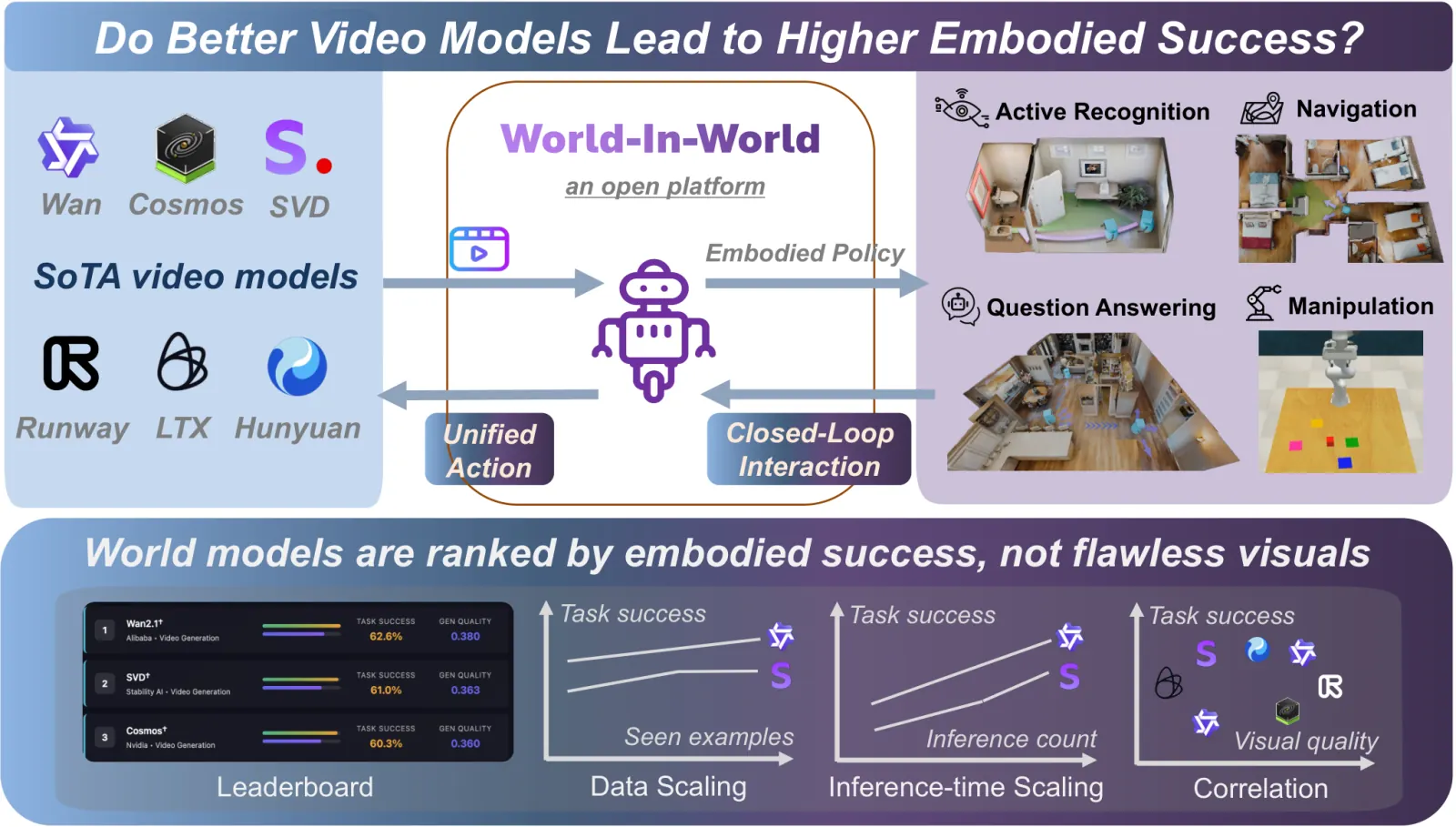
World-in-World (Johns Hopkins, with PKU, Princeton, MIT, and Harvard; ICLR 2026 Oral) benchmarks generative world models in a closed loop that mirrors agent–environment interaction. Task success beats visual quality. A unified online planner and a standardized action API cover four environments:
- Active Recognition
- Active Embodied QA
- Image-Goal Navigation (success + SPL)
- Robotic Manipulation
The paper's findings: visual quality alone does not guarantee success (controllability matters more); action-observation post-training beats upgrading the video generator; inference-time compute helps closed-loop performance.
world_in_world_average is the mean over available closed-loop metrics.
Paper: World-in-World. Project: world-in-world.github.io. Code: World-In-World/world-in-world.
WorldFoundry is a result importer. Closed-loop environments, planners, workers, and task scorers execute upstream. Bundled assets support parsing and coverage checks only.
Dimensions
- Active RecognitionKindTask
Closed-loop recognition success.
- Active Embodied QAKindTask
Answer score plus exploration SPL.
- Image-Goal NavigationKindTask
Success rate and SPL.
- Robotic ManipulationKindTask
Closed-loop manipulation success.
Data composition
- Size
ICLR 2026 oral closed-loop utility bench. Four environments with a unified planner and action API. Task success over visual quality.
- Sources
github.com
- Modalities
video · action · observation
- Notes
WorldFoundry imports task summaries only. Closed-loop runtime parity is pending.
Metrics
Metric
- DirectionHigher is better
active_recognition_success_rateactive_recognition_success_rate normalized benchmark score.
- DirectionHigher is better
image_goal_navigation_success_rateimage_goal_navigation_success_rate normalized benchmark score.
- DirectionHigher is better
image_goal_navigation_splimage_goal_navigation_spl normalized benchmark score.
- DirectionHigher is better
active_embodied_qa_scoreactive_embodied_qa_score normalized benchmark score.
- DirectionHigher is better
active_embodied_qa_splactive_embodied_qa_spl normalized benchmark score.
- DirectionHigher is better
robotic_manipulation_success_raterobotic_manipulation_success_rate normalized benchmark score.
- DirectionHigher is better
interaction_trace_consistencyinteraction_trace_consistency normalized benchmark score.
- DirectionHigher is better
world_in_world_averageworld_in_world_average normalized benchmark score.
PrimaryWorld In World Average
Leaderboard
Results from the paper (not a live board; not WorldFoundry-run scores). Paper Active Recognition SR. † = video-generation post-train. World-in-World: World Models in a Closed-Loop World (2025).
| Model | Active Recognition success |
|---|---|
| WAN2.1 †post-train | 62.98 |
| SVD †post-train | 60.62 |
| Wan2.1 | 58.26 |
| SVD | 57.71 |
| Hunyuan | 57.71 |
| SE3DS | 57.53 |
| Heuristic (w/o WM) | 39.02 |
How to run
worldfoundry-eval zoo benchmark-run \
  --benchmark-id world-in-world \
  --mode official-validation \
  --official-results-path <official_results.json> \
  --generated-artifact-dir <generated_videos> \
  --output-dir tmp/world-in-world/official-validation \
  --json
Optional --task / --exp-id scope the import. Default: WORLDFOUNDRY_WORLD_IN_WORLD_RESULTS_PATH.
In-tree pointers: worldfoundry/data/benchmarks/tasks/external/world-in-world.yaml, worldfoundry/data/benchmarks/assets/world-in-world, worldfoundry/evaluation/tasks/execution/runners/world_in_world.
Outputs include scorecard.json (primary world_in_world_average).