WorldGen
ZiYang Xie WorldGen: text or image in, traversable 3D splat/mesh out. In-tree adapter; gated FLUX foundations; runner parity pending.
WorldGen on this card is ZiYang Xie's open 3D-world generator (github.com/ZiYang-xie/WorldGen, project worldgen.github.io). At runtime it turns a text prompt and/or a single image into a 3D scene — default Gaussian splat worldgen.ply, or a mesh worldgen.glb when return_mesh is set. It does not emit world video.
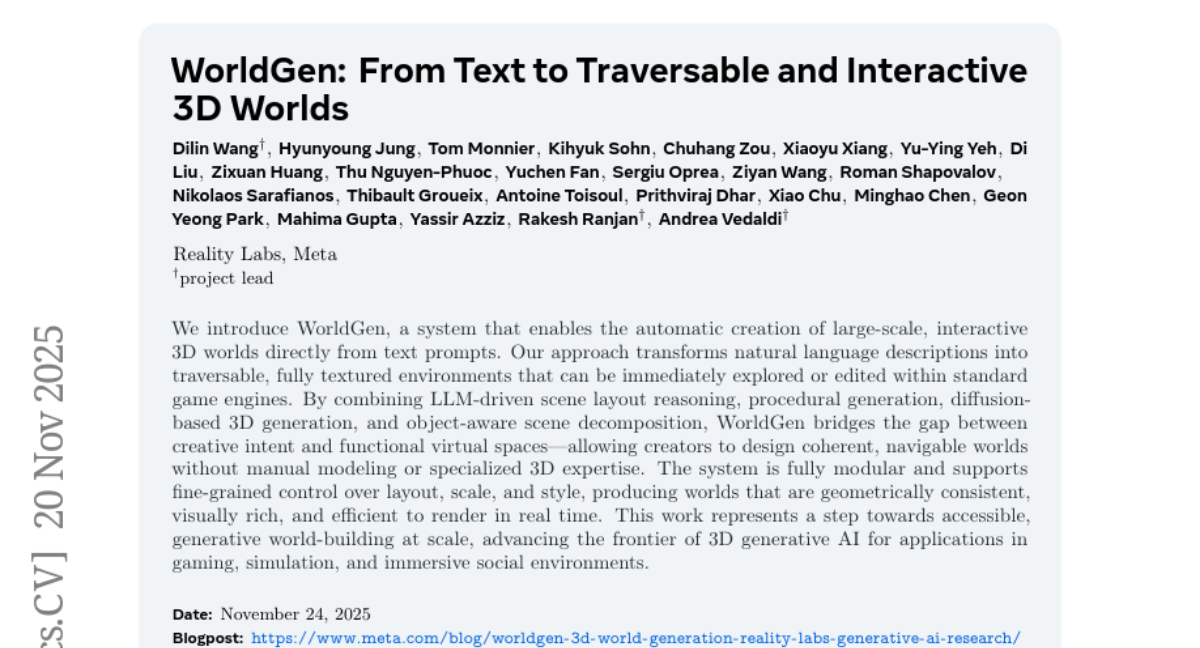
The catalog paper URL and title-page thumb are Meta Reality Labs' WorldGen: From Text to Traversable and Interactive 3D Worlds. That is a different project with the same name. This page documents the LeoXie/WorldGen adapter WorldFoundry actually wires, not Meta's release. It is also not Hunyuan World worldgen.
Build your run
WorldGenPipelineworldfoundry.pipelines.three_d_four_d.pipeline_runtimedefaultworldfoundry.pipelineworldfoundry-eval run \
worldgen \
--pipeline.task-profile default \
--jsonWhat it is for
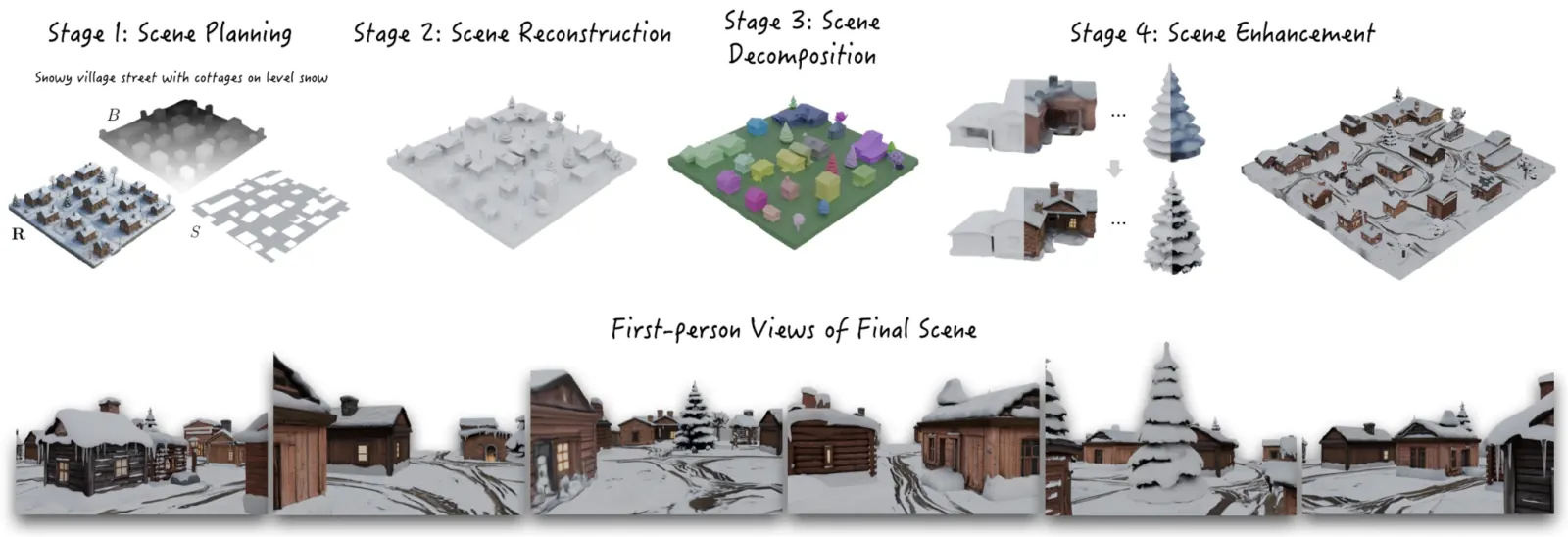
Build a walkable 3D asset, not a clip. Launch worldfoundry-eval run worldgen. Recorded inputs: prompt and image. Optional actions.camera_path. Video is not a required input. The in-tree flow is text-to-scene (t2s) or image-to-scene (i2s): FLUX paints a panorama, then the adapter reconstructs splat or mesh. You can also pass a ready panorama and skip FLUX generation.
Default inference resolution in the vendored script is 1600. Low-VRAM mode turns on automatically below 24 GB. Background inpaint cannot combine with return_mesh.
Score generated 3D worlds on WorldScore. That is a catalog entry point, not an ingested WorldFoundry score.
Running in WorldFoundry
WorldGenPipeline is an in-tree subprocess adapter in worldfoundry-unified-cu128 (Python 3.11, CUDA 12.8). Stage LeoXie/WorldGen and accept the gated FLUX.1-dev (text-to-pano) and FLUX.1-Fill-dev (image-to-pano) terms. Missing foundations are reported at inference time. Runner / official scene-quality parity is pending.
A local 512×256, 50-step text-to-scene run produced a finite Gaussian-splat scene with the requested furniture. A cropped perspective-photo image-to-scene run produced a valid PLY but did not preserve its input room. The current upstream image path maps a single input across spherical panorama rays without a specified camera field of view. A separate full 2:1 panorama exposed a contour-fill bug that erased every conditioned pixel when the image covered the whole sphere; the in-tree fix preserves the full mask. Repeating the 50-step run with that panorama produced a valid PLY whose recovered RGB differed from the input by 1.44/255 on average. Because the full panorama leaves nothing to inpaint, this verifies condition preservation and scene conversion, not novel expansion from a perspective photograph.