
BridgeData V2
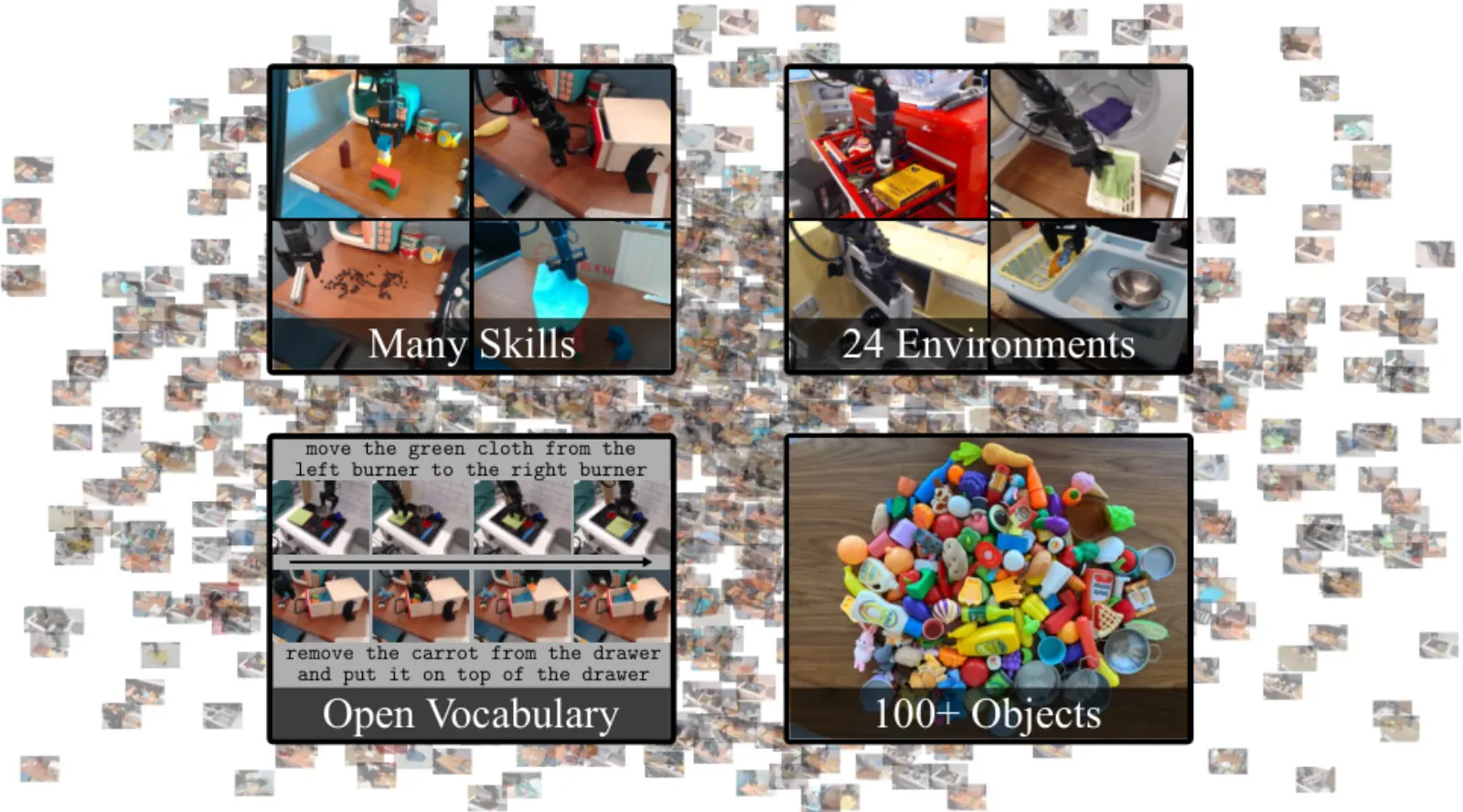
BridgeData V2 (UC Berkeley RAIL) is a real-robot manipulation dataset for open-vocabulary, multi-task policies. Official numbers: 60,096 trajectories on a WidowX 250 6-DoF arm across 24 environments (13 skills) — 50,365 VR teleop demos and 9,731 scripted pick-and-place rollouts. Seven toy kitchens dominate; the rest are tabletops, sinks, and similar. Control is 5 Hz (mean length ~38 steps). Sensing is 640×480: fixed RGB-D over-the-shoulder, two randomized RGB views, and a wrist camera. Every trajectory has a language label; eval is language-conditioned (eval_lc) or goal-image-conditioned (eval_gc).
Paper: BridgeData V2. Project: rail-berkeley.github.io/bridgedata. Code: rail-berkeley/bridge_data_v2 (MIT). Official media are HTTP / project-page downloads, not a single Hugging Face table.
WorldFoundry imports policy-evaluation exports (task / goal success, offline action accuracy, rollout success). It does not materialize the dataset, run WidowX inference, or execute real-robot rollouts. Stage data under ${WORLDFOUNDRY_DATA_DIR}/datasets/bridgedata-v2 if you need it locally.
Dimensions
- Language-conditioned evalKindTrack
Open-vocabulary instructions on the WidowX 250. Official eval_lc path.
- Goal-image-conditioned evalKindTrack
Goal-image conditioning (official eval_gc). Distinct from language success.
- Teleop vs scripted pick-and-placeKindSplit
50,365 VR-teleoperated demonstrations and 9,731 scripted pick-and-place rollouts.
- 13 skills / 24 environmentsKindCategory
Pick-and-place, push, sweep, stack, fold, and related skills across toy kitchens, sinks, and tabletops.
Data composition
- Size
UC Berkeley RAIL real-robot set: 60,096 WidowX 250 6-DoF trajectories in 24 environments (7 toy kitchens plus tabletops, sinks, laundry). 5 Hz, ~38-step mean length, 640×480 RGB-D / wrist / randomized third-person views, every trajectory language-labeled. Official download is HTTP / project-page, not a single Hugging Face table.
- Sources
github.com
- Splits
eval
- Modalities
language · vision · action · state · proprioception
- License
MIT
- Notes
Code repo is MIT. Dataset materialization follows the project-page HTTP release. Hugging Face copies in the wild are third-party conversions.
Metrics
Metric
- DirectionHigher is better
success_ratePrimary task success over imported policy evaluations.
PrimarySuccess Rate
- DirectionHigher is better
task_successPer-task success aggregate.
- DirectionHigher is better
goal_successGoal-image-conditioned task success (eval_gc).
- DirectionHigher is better
action_accuracyOffline action-prediction accuracy against reference actions.
- DirectionHigher is better
rollout_successSuccess over executed real-robot or official scripted rollouts.
Leaderboard
Results from the paper (not a live board; not WorldFoundry-run scores). Author comparison of BridgeData V2 vs V1+PTR on the paper’s two evaluated tasks. BridgeData V2: A Dataset for Robot Learning at Scale (2023).
| Model | Average success (2 reported tasks) |
|---|---|
| BridgeData V2 | 0.70 |
| BridgeData V1 + PTR | 0.08 |
How to run
worldfoundry-eval zoo benchmark-run \
  --benchmark-id bridgedata-v2 \
  --mode official-validation \
  --official-results-path <official_results.json> \
  --output-dir tmp/bridgedata-v2/official-validation \
  --json
Default import path: WORLDFOUNDRY_BRIDGEDATA_V2_RESULTS_PATH. Manifest: worldfoundry/data/benchmarks/tasks/external/bridgedata-v2.yaml. Declare language vs goal-image (and teleop vs scripted) with the export. Outputs: scorecard.json (primary success_rate; also goal_success, action_accuracy, rollout_success) and raw_results.jsonl.