Self-Forcing
Self-Forcing from Adobe Research / The University of Texas at Austin: text-to-video and autoregressive video generation; Verified; Self Forcing.
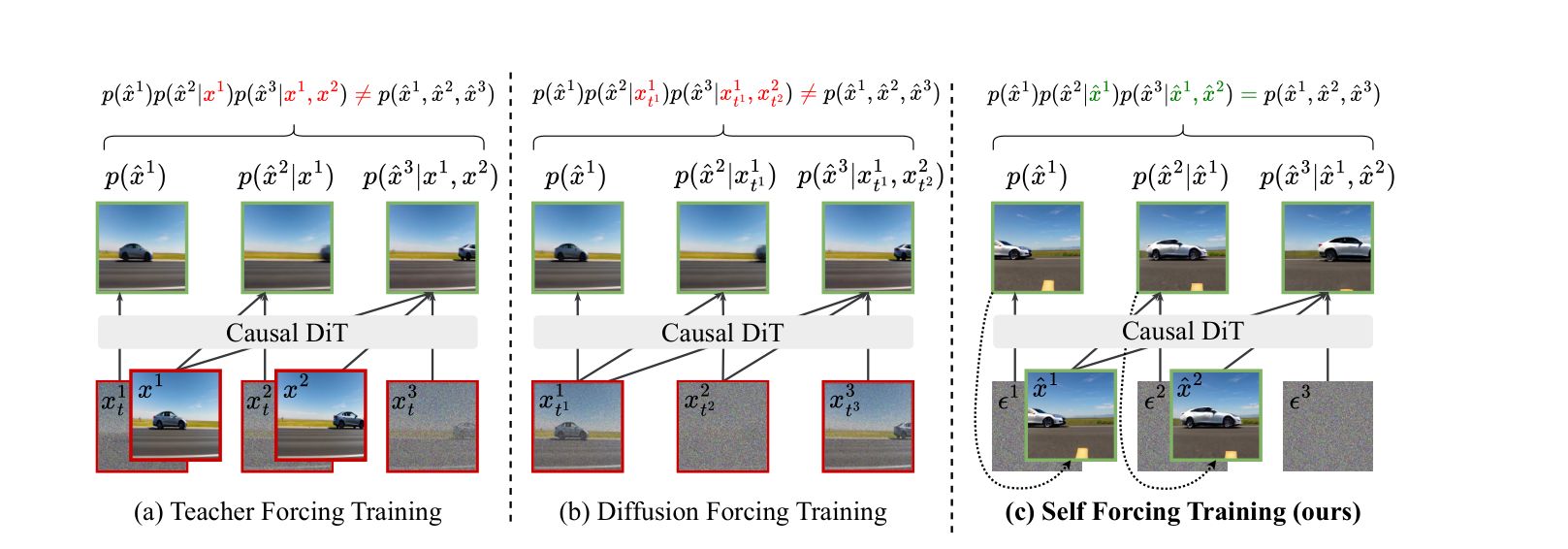
Self-Forcing bridges the train-test gap in autoregressive video diffusion: by simulating the inference process during training — conditioning each frame on its own previously generated frames — it enables real-time streaming text-to-video on a single GPU (arXiv 2506.08009). WorldFoundry serves it as a native diffusion recipe, offline and as a realtime stream, bitwise equal to the official inference script given the official noise draws.
Paper: Self Forcing: Bridging the Train-Test Gap in Autoregressive Video Diffusion (NeurIPS 2025 spotlight, 2025).
Project page: self-forcing.github.io. Code: guandeh17/Self-Forcing.
Build your run
NativeSelfForcingPipelineworldfoundry.pipelines.forcing.pipeline_native_forcinginteractive-videoworldfoundry.pipelinewf run \
self-forcing \
--pipeline.task-profile interactive-video \
--jsonWhat it is for
self-forcing generates a video clip from a text prompt.
The causal Wan2.1 T2V 1.3B generator (gdhe17/Self-Forcing, self_forcing_dmd.pt) denoises three-latent-frame blocks in four distilled x0 steps at timesteps 1000, 750, 500 and 250 on the shift-5 flow calendar, then commits each clean block to a 21-latent-frame KV cache at timestep 0. It is published by Adobe Research / The University of Texas at Austin.
Tasks: text-to-video and autoregressive video generation. Aliases: Self-Forcing, selfforcing, and self_forcing. Modalities: text in, video out.
Suggested benchmarks: VBench (Video quality for streaming text-to-video).
Runtime contract
Inputs prompt (bundled samples are used when omitted); options frames, fps, height, width, and seed; artifacts self-forcing.mp4.
CLI task profiles: interactive-video. WorldFoundry binds NativeSelfForcingPipeline.
Family status: Verified.
Defaults for interactive-video: frames=81, fps=16, height=480, width=832, seed=0.
Defaults follow the official CLI: 480x832, 81 frames (21 latent frames), four steps, guidance 1.0, 16 fps; num_frames must give a multiple of three latent frames up to 21. The realtime session emits 9 frames for the first block and 12 for each later block, 7 chunks for 81 frames. Loading with kv_window="sink5-window7-rerope" selects the approximate long-rollout cache for longer videos and unbounded streams.
Running in WorldFoundry
Run wf run self-forcing --pipeline.task-profile interactive-video to generate the video.
It runs in the unified environment worldfoundry-unified-cu128 (Python 3.11, CUDA 12.8).
Weights: gdhe17/Self-Forcing and Wan-AI/Wan2.1-T2V-1.3B. Prepare the environment and check local assets with bash scripts/inference/prepare_model_infer.sh self-forcing. Add --download to fetch missing public checkpoints.