
Causal-Forcing
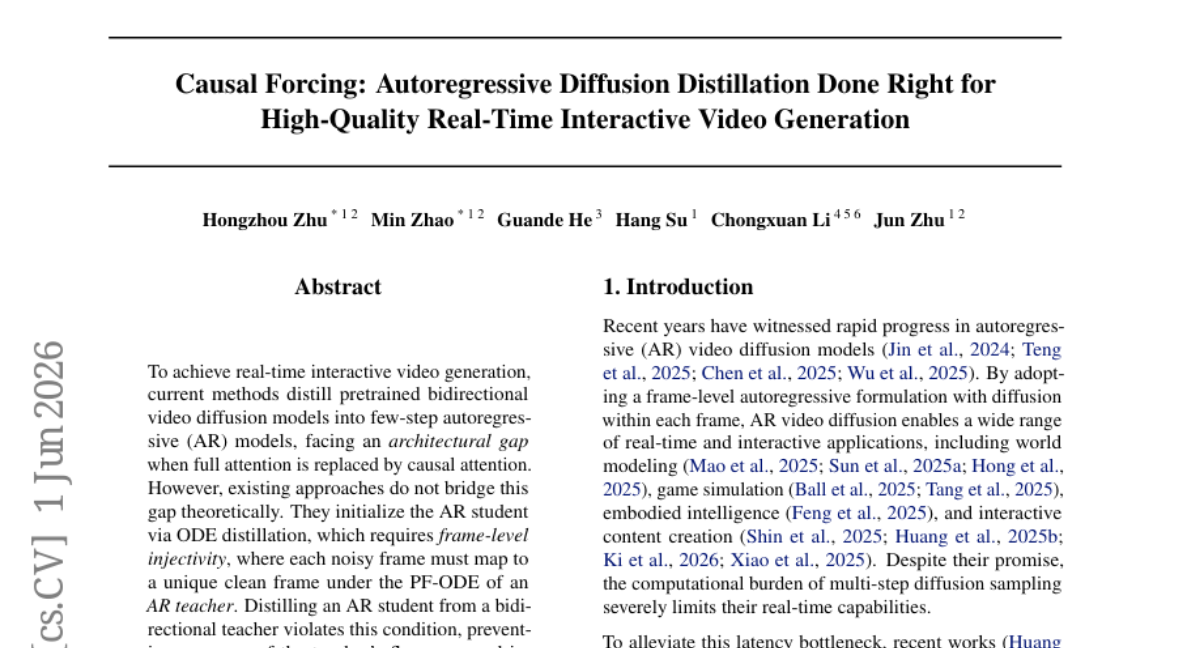
Tsinghua thu-ml causal video students distilled from Wan2.1, served as native WorldFoundry recipes. Default chunk-wise T2V at 832×480, 81 frames, 4 steps; the frame-wise student also takes an image. Bitwise equal to the official inference script given the official noise draws.
Causal-Forcing distills a bidirectional Wan2.1 teacher into a causal autoregressive student so video can stream chunk by chunk or frame by frame instead of in one bidirectional pass. Causal-Forcing++ is the few-step line on the same card (aliases Causal Forcing++ and causal-forcing-plus-plus). WorldFoundry runs every released student as a native diffusion recipe through NativeCausalForcingPipeline, offline and as a realtime stream. This is not Self-Forcing and not Rolling-Forcing.
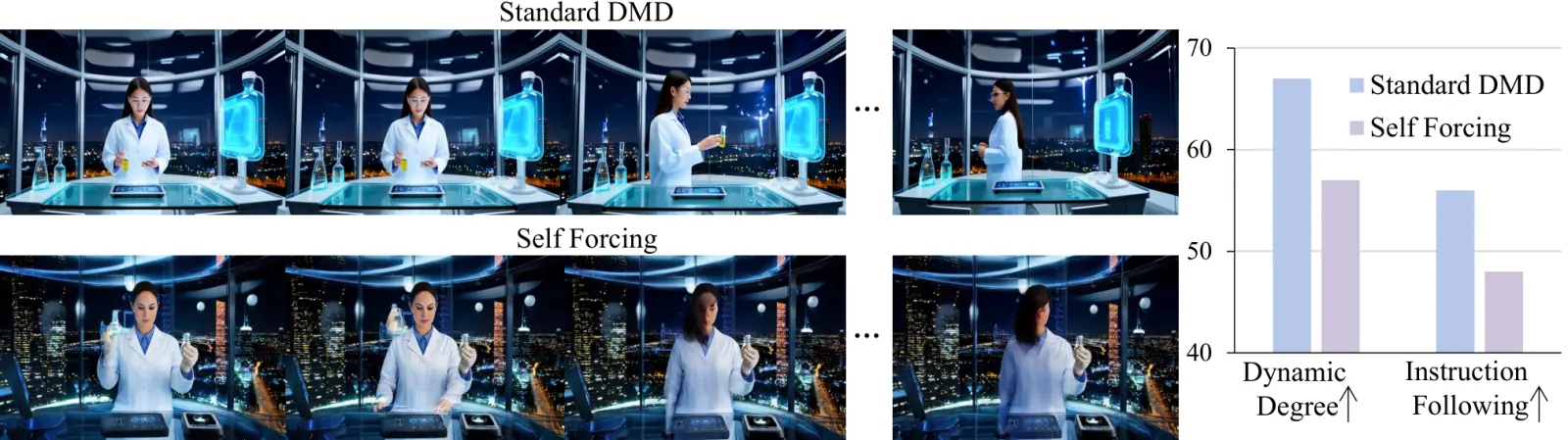
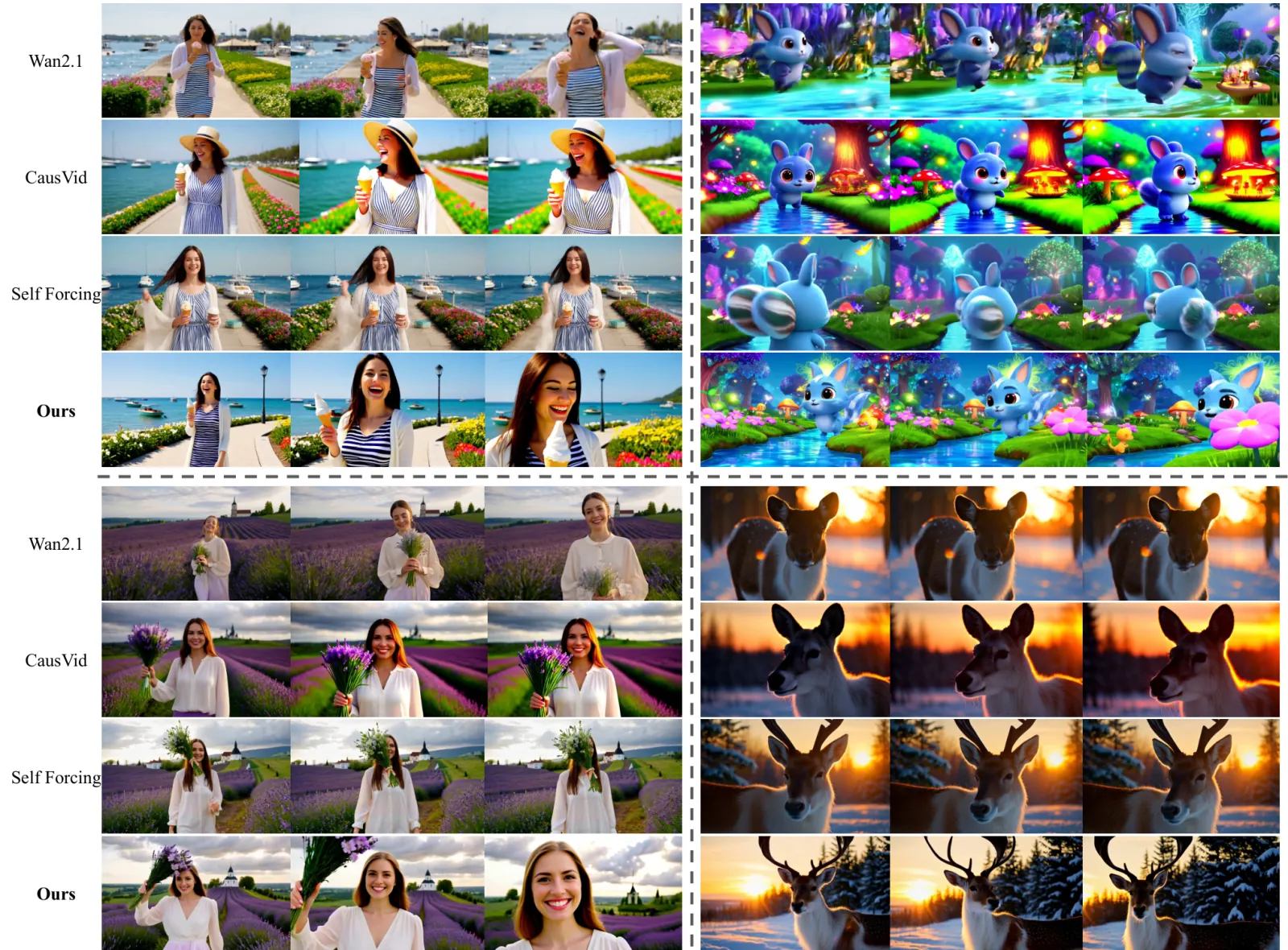
The official paper is Causal Forcing: Autoregressive Diffusion Distillation Done Right for High-Quality Real-Time Interactive Video Generation (ICML 2026, arXiv 2602.02214). The ++ write-up is arXiv 2605.15141. Project: thu-ml.github.io/CausalForcing.github.io. Code: thu-ml/Causal-Forcing. Publisher: Tsinghua University (thu-ml). Weights: zhuhz22/Causal-Forcing.
Build your run
NativeCausalForcingPipelineworldfoundry.pipelines.forcing.pipeline_native_forcinginteractive-videoworldfoundry.pipelinewf run \
causal-forcing \
--pipeline.task-profile interactive-video \
--jsonWhat it is for
Start on the chunk-wise student for text-to-video: wf run causal-forcing. The artifact is causal-forcing.mp4.
Image-to-video is frame-wise only. Load the frame-wise student with variant: causal-forcing-framewise and pass one image; the chunk-wise and ++ students reject image input.
Use ++ only when you deliberately want 1- or 2-step sampling. Both students still spend 4 steps on the first frame ([1000, 750, 500, 250], the first-frame schedule the ++ release records).
Score clip quality on VBench. Supply a prompt through --pipeline.prompt.
Variants
NativeCausalForcingPipeline (worldfoundry.pipelines.forcing.pipeline_native_forcing) loads one recipe per release file. The public causal-forcing ID loads the chunk-wise student; variant (or model_id) selects another:
| Variant | Checkpoint (zhuhz22/Causal-Forcing) | Weights | Latent frames per block | Steps per block | Image input |
|---|---|---|---|---|---|
causal-forcing-chunkwise (default) | chunkwise/causal_forcing.pt | generator | 3 | 4: [1000, 750, 500, 250] | no |
causal-forcing-framewise | framewise/causal_forcing.pt | generator_ema | 1 | 4: [1000, 750, 500, 250] | optional first frame |
causal-forcing-framewise-1step | causal-forcing++/framewise-1step.pt | generator_ema | 1 | 4 on the first frame, then 1: [1000] | no |
causal-forcing-framewise-2step | causal-forcing++/framewise-2step.pt | generator_ema | 1 | 4 on the first frame, then 2: [1000, 500] | no |
All four share the components of native Self-Forcing: the causal Wan2.1 1.3B graph with a 21-latent-frame global KV cache, the autoregressive-window runner with distilled x0 prediction on the shift-5 calendar, the Wan2.1 umT5 text encoder and the bf16 Wan2.1 VAE. Each release file holds one generator state dict. The loader strips the model. and FSDP prefixes and loads it strictly.
Runtime contract
| Knob | Default | Notes |
|---|---|---|
| Size | 832×480 | height: 480, width: 832 |
| Frames | 81 | 21 latent frames, the cache size; the latent frame count must be a multiple of the block size |
| FPS | 16 | |
| Steps | 4, or 1 / 2 for ++ | the variant's released step list; other counts are rejected |
| Guidance | 1.0 | distilled students run without classifier-free guidance |
| Seed | 0 | |
| Dtype | bfloat16 |
Image-to-video follows the official --i2v route. The image is resized with torchvision Resize((height, width)) (no aspect-preserving crop), normalized to [-1, 1], and encoded by the bf16 Wan2.1 VAE. Its latent is committed to the KV cache at timestep 0 as latent frame 0, and the rollout generates the remaining 20 latent frames.
Frame-wise students re-noise between steps in bf16, as the official scheduler does for a one-frame block of one sample; chunk-wise blocks re-noise in float32.
Realtime. The pipeline keeps one rollout resident (prepare_realtime, configure_realtime, stream_realtime, reset_realtime). Each stream_realtime call commits and decodes one latent block at 16 fps with advance="continuous", and a new prompt reopens the rollout:
| Variant | First chunk | Later chunks | Chunks at 81 frames |
|---|---|---|---|
| Chunk-wise | 9 frames | 12 frames | 7 |
| Frame-wise and Causal Forcing++, text only | 1 frame | 4 frames | 21 |
| Frame-wise with an image | 5 frames (image frame and first block) | 4 frames | 20 |
Running in WorldFoundry
wf run causal-forcing runs in worldfoundry-unified-cu128 (Python 3.11, CUDA 12.8), the same environment as Self-Forcing. Select a variant with --pipeline.load.variant causal-forcing-framewise. The generator resolves from zhuhz22/Causal-Forcing staged as $WORLDFOUNDRY_CKPT_DIR/zhuhz22--Causal-Forcing (or Causal-Forcing) or in the Hugging Face cache, and the text encoder, tokenizer and VAE from Wan-AI/Wan2.1-T2V-1.3B. Studio passes the staged release directory, and each variant reads its own file from it. Checkpoints that are not staged locally are fetched at the pinned revision. No license is stated — confirm the GitHub / Hugging Face cards before any production use.
To pin every file, pass checkpoint_overrides:
from worldfoundry.pipelines.forcing.pipeline_native_forcing import NativeCausalForcingPipeline

wan = "<ckpts>/Wan-AI--Wan2.1-T2V-1.3B"
pipeline = NativeCausalForcingPipeline.from_pretrained(
    variant="causal-forcing-framewise",
    device="cuda",
    torch_dtype="bf16",
    offload_mode="none",
    checkpoint_overrides={
        "dit": "<ckpts>/zhuhz22--Causal-Forcing/framewise/causal_forcing.pt",
        "text-encoder": wan,
        "tokenizer": wan,
        "vae": wan,
    },
)
t2v = pipeline(prompt="A red fox walks through a sunlit forest.", seed=42, return_dict=True)
i2v = pipeline(prompt="An abandoned room.", images="testcase/012_abandoned-room.png", seed=42, return_dict=True)
Validation
tests/manual/self_forcing_parity.py --model-id <variant> compares a variant with the official inference script on the first MovieGenVideoBench prompt (seed 42, 480×832, 21 latent frames, bf16), with the official initial-noise and re-noise draws injected. All four T2V variants and frame-wise I2V match the official script bitwise at every stage, from checkpoint loading and prompt embeddings to the final latents and the decoded video, both as one clip and as streamed chunks.
Minimal eval
Chunk-wise T2V, then VBench custom_input / aesthetic_quality.