
Helios
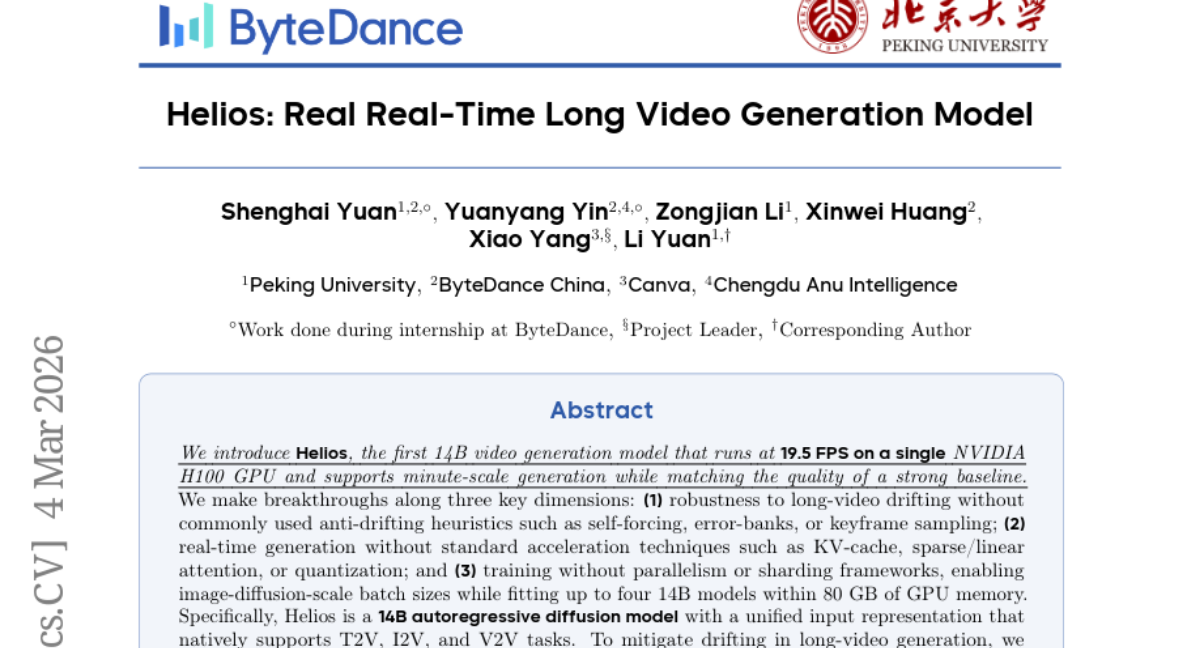
PKU / ByteDance 14B autoregressive long-video model on Wan2.1-T2V-14B weights. Distilled/Mid/Base variants; dedicated Helios environment.
Helios is a 14B autoregressive video generator from Peking University's Yuan Group (with ByteDance / Canva). It starts from Wan2.1-T2V-14B weights and emits long video in chunks instead of running the bidirectional Wan stack for every clip. The paper is Helios: Real Real-Time Long Video Generation Model; the project page is pku-yuangroup.github.io/Helios-Page. The authors' headline claim is 19.5 FPS on a single H100 for minute-scale generation, without KV-cache, sparse attention, or quantization as the speed story.
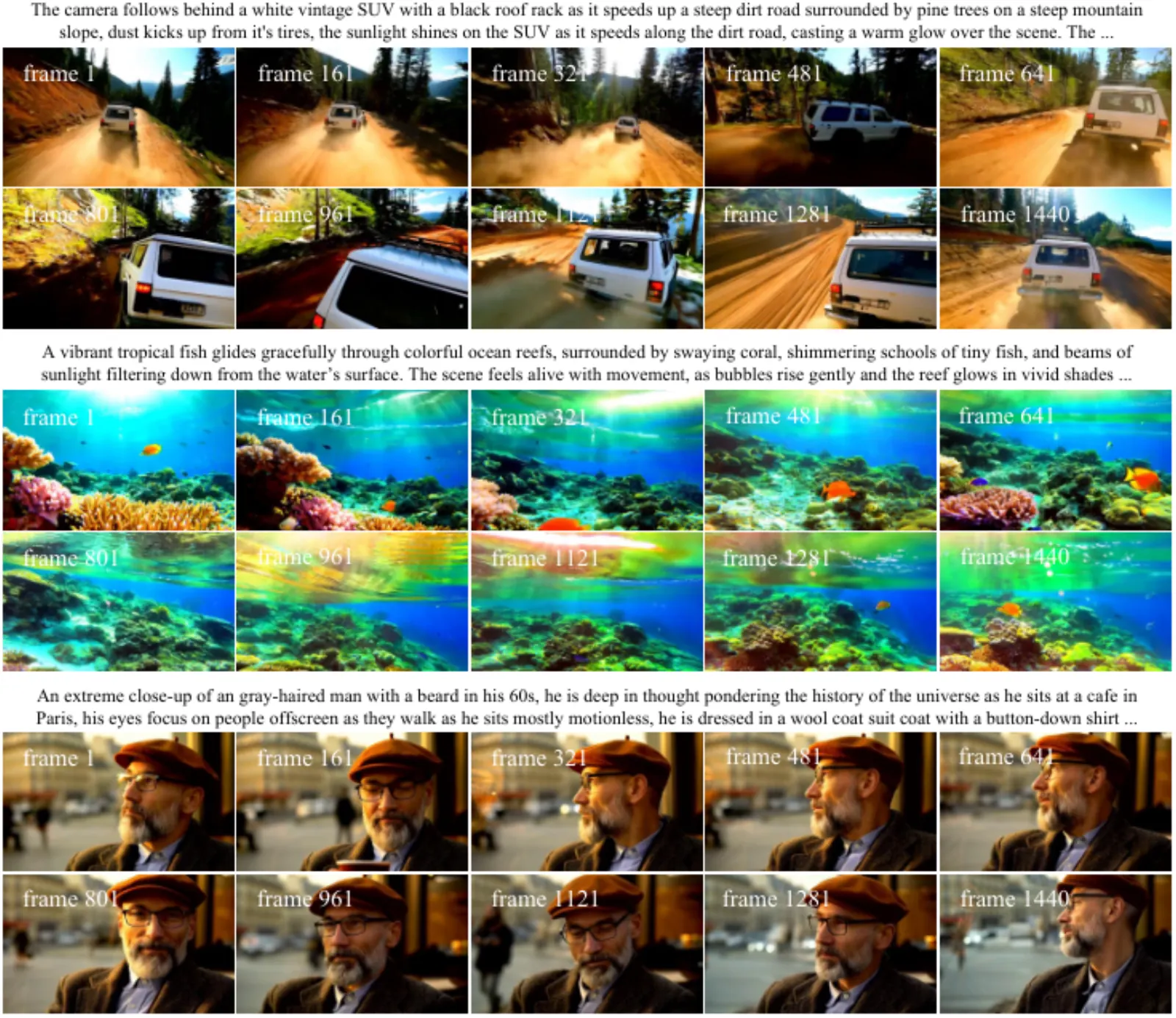
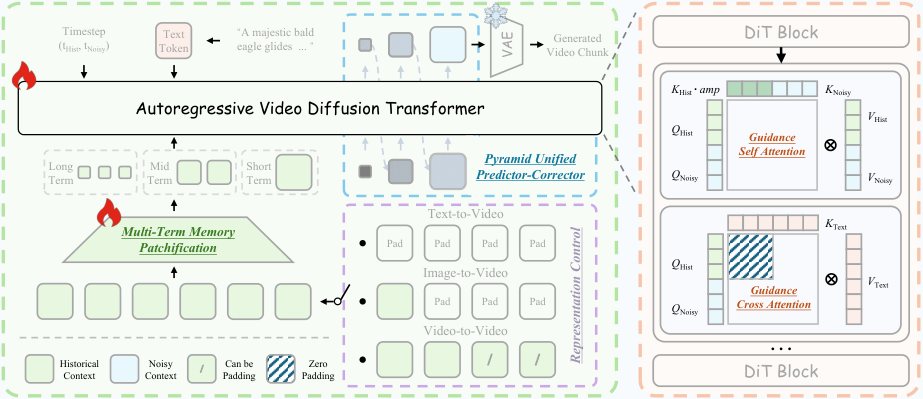
WorldFoundry vendors the inference implementation and exposes three checkpoints. helios-distilled (default) is the fast line: about 3 sampling steps and no CFG. helios-mid adds Pyramid Unified Predictor-Corrector token compression. helios-base is the quality line (official pyramid [20,20,20], on the order of 50 steps). Distilled resident sessions keep a native 9-latent / 33-frame history and accept prompt_update between segments — there is no keyboard or camera control.
The in-tree pipeline generates in 33-frame chunks and rounds requested lengths up to a compatible chunk count. Recorded defaults: 384×640, 240 requested frames, 24 fps, num_inference_steps=50 (Distilled overrides this toward 3). The default route also accepts T2V, I2V, and V2V. Group offloading and multi-GPU context parallelism are exposed as runtime options.
Build your run
HeliosPipelineworldfoundry.pipelines.helios.pipeline_heliostext-to-videoworldfoundry.pipelineworldfoundry-eval run \
helios-distilled \
--pipeline.task-profile text-to-video \
--jsonVariants
- StatusRunner parity pending
helios-distilledtext-to-video
Runtime profile
heliosPipeline binding
helios - StatusRunner parity pending
helios-basetext-to-video
Runtime profile
heliosPipeline binding
helios - StatusRunner parity pending
helios-midtext-to-video
Runtime profile
heliosPipeline binding
helios
What it is for
Generate long video when a bidirectional Wan2.1-14B job would be too slow. Start on helios-distilled for iteration; switch to helios-base only when you need the quality recipe and can wait. ChronoMagic-Bench matches the long-horizon focus; VBench is the short-clip quality suite. Neither is an ingested WorldFoundry board.
Runtime contract
Required: prompt. Optional: negative_prompt, num_frames, height, width, fps, num_inference_steps, guidance_scale (default auto). Pipeline: HeliosPipeline. Artifact: generated video. Unified History Injection always feeds a clean history chunk and a noisy future chunk together so long rollouts do not drift as quickly as a naive autoregressive loop.
Running in WorldFoundry
Use the dedicated environment worldfoundry-helios-cu128 (Python 3.11.2, CUDA 12.8, torch==2.10.0). Launch worldfoundry-eval run helios-distilled (or helios-mid / helios-base) with --pipeline.task-profile text-to-video. Runner status is Runner parity pending (visual QA): import-light preflight is unit-tested, but full 240-request-frame visual parity still needs that environment plus a GPU run. The recorded Base A100 smoke used a 3-step [1,1,1] pyramid — it proves wiring and a non-blank artifact, not the official [20,20,20] quality recipe. Weights: BestWishYsh/Helios-Distilled, Helios-Mid, Helios-Base.