
Pusa VidGen
![Method overview: Diverse Applications of FVDM. (a) Standard Video Generation: Implements uniform timestep across frames, [ t , t , … , t ] [t,t,,t] . (b) Image-to-Video Generation: Transforms a static image into a video using a.](/WorldFoundry/models/pusa-vidgen/paper.png)
Pusa VidGen from City University of Hong Kong: image-to-video and text-to-video; Runner parity pending.
Pusa VidGen (Pusa V1) demonstrates vectorized timestep adaptation: instead of one shared diffusion timestep for the whole video, each frame gets its own, which unlocks image-to-video, text-to-video, and video extension from one cheap LoRA training run on Wan2.2. WorldFoundry assembles it entirely from canonical Wan2.2 components — no external runtime checkout is needed at inference time.
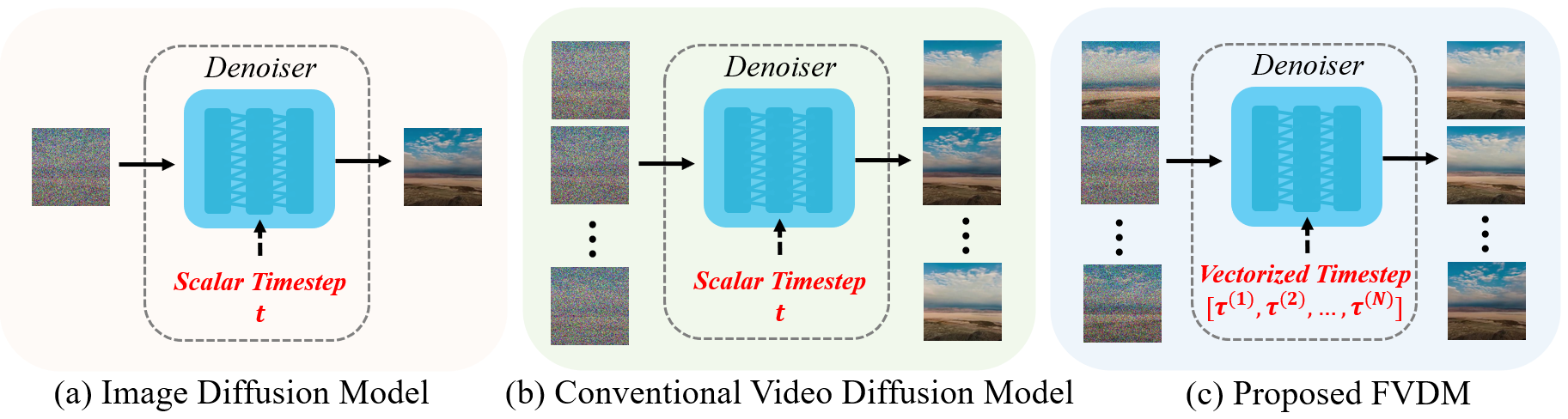
![Method overview: Diverse Applications of FVDM. (a) Standard Video Generation: Implements uniform timestep across frames, [ t , t , … , t ] [t,t,,t] . (b) Image-to-Video Generation: Transforms a static image into a video using a.](/WorldFoundry/models/pusa-vidgen/overview.png)
The recorded paper is arXiv 2410.03160.
Project page: pusav1.org. Code: Yaofang-Liu/Pusa-VidGen.
Build your run
PusaVidGenPipelineworldfoundry.pipelines.pusa_vidgen.pipeline_pusa_vidgendefaultworldfoundry.pipelineworldfoundry-eval run \
pusa-vidgen \
--pipeline.task-profile default \
--jsonWhat it is for
pusa-vidgen is the recorded text/image-to-video line. Use it when you want both prompt and still conditioning on the same catalog card.
Pusa V1 = Wan2.2 base (canonical denoisers, conditioner, VAE, loaders, shared staged runner) + the official Pusa V1 LoRA checkpoint (RaphaelLiu/Pusa-Wan2.2-V1). The vectorized-timestep behavior comes from the LoRA; no alternate diffusion backend is involved. It is published by City University of Hong Kong.
Catalog tasks include image-to-video, text-to-video, and video-extension. Catalog aliases include pusa-v1 and pusa-wan2.2-v1. Documented modalities: image and text in, video out.
Recorded evaluation entry points include VBench (General T2V/I2V quality suite).
Runtime contract
Optional prompt, negative_prompt, interactions, frames, and fps; artifacts generated_video and pusa_vidgen_public_runner.mp4.
CLI task profiles: default. WorldFoundry binds PusaVidGenPipeline.
Family status: Runner parity pending.
Recorded default defaults: frames=81, height=720, width=1280, seed=0.
Runner status is Runner parity pending: the model-specific pipeline exposes generated_video through execute=True and no longer emits request-plan artifacts on default calls. Stage the Wan2.2 base weights plus the Pusa LoRA before running.
Running in WorldFoundry
The catalog launch is worldfoundry-eval run pusa-vidgen --pipeline.task-profile default. The command builder above switches --pipeline.task-profile among recorded tasks and still emits worldfoundry-eval run.
It runs in the unified environment worldfoundry-unified-cu128 (Python 3.11, CUDA 12.8).
Recorded weight repositories include RaphaelLiu/Pusa-Wan2.2-V1, Wan-AI/Wan2.2-T2V-A14B, and lightx2v/Wan2.2-Lightning. Prepare the environment and check local assets with bash scripts/inference/prepare_model_infer.sh pusa-vidgen. Add --download to fetch missing public checkpoints.
Status: Runner parity pending.