
Stable Video Infinity 2.0
Stable Video Infinity 2.0 from EPFL (VITA lab): image-to-video and long-video-generation; Verified.
Stable Video Infinity 2.0 (SVI) generates arbitrarily long videos by chaining clips with five-frame continuation and per-clip seed changes, driven by prompt streams. This is one of the strongest evidence entries in the catalog: runner status is Verified, with a recorded A100 run producing two linked 81-frame clips at 832x544 and a 157-frame H.264 artifact, plus 31.03 dB PSNR exact-setting parity against the pinned official runtime.
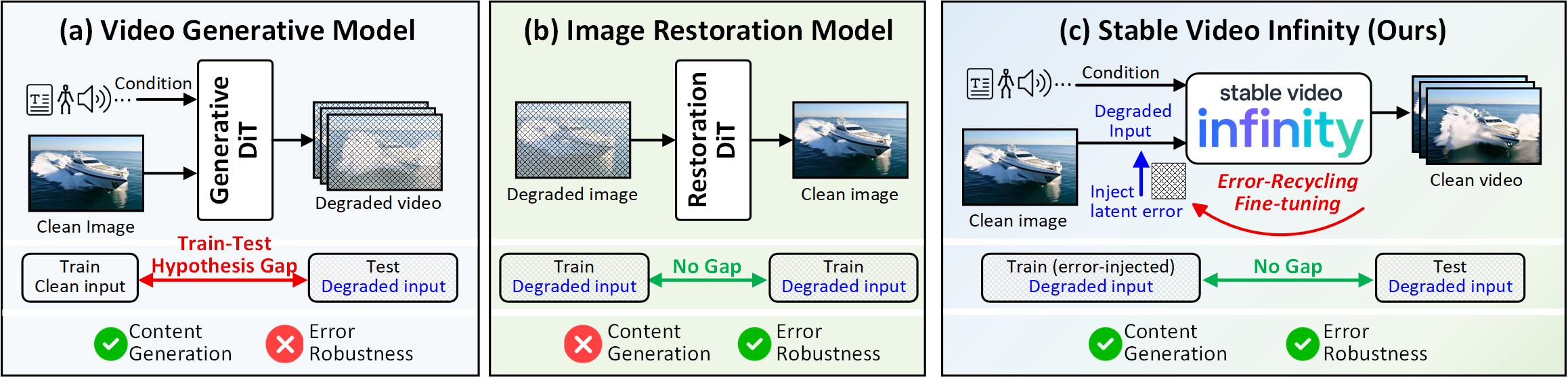
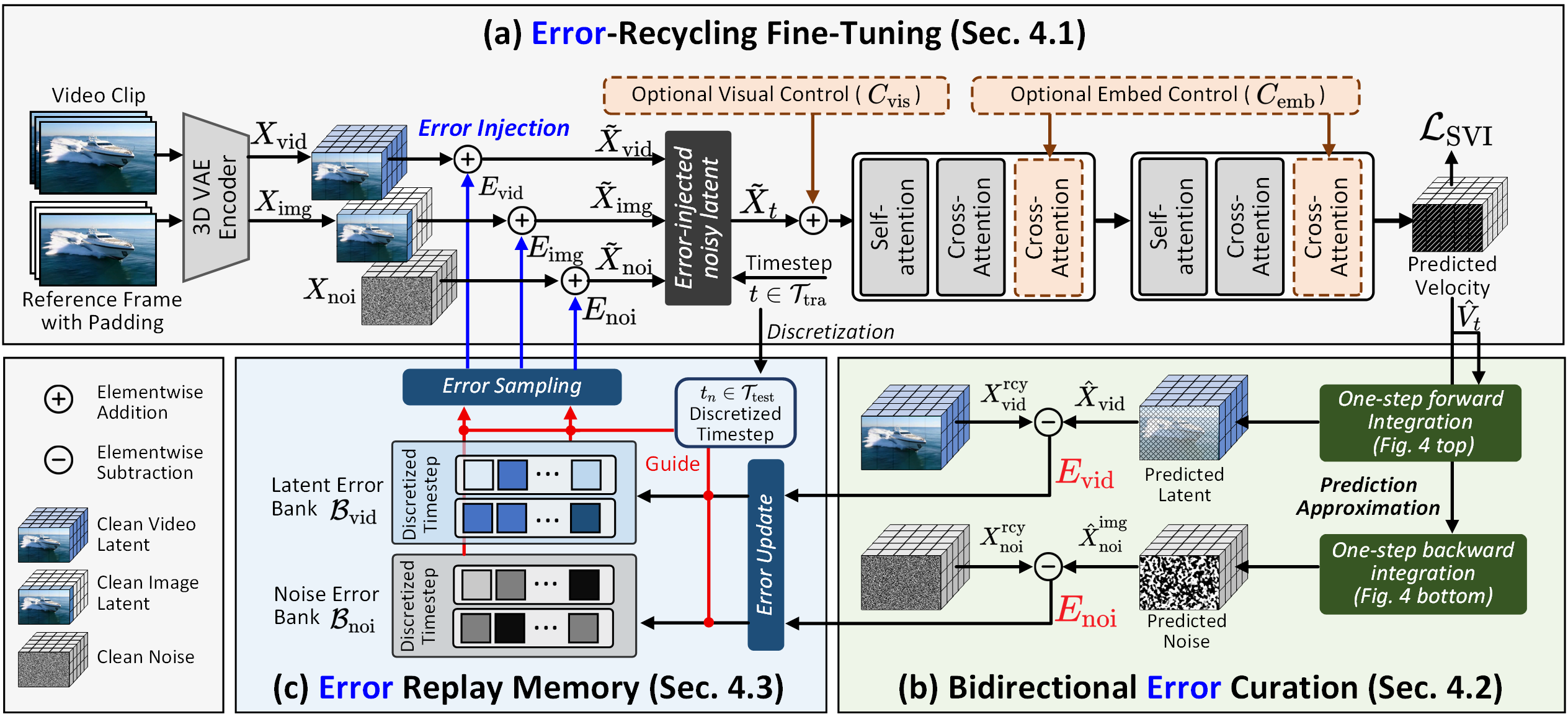
The recorded paper is Stable Video Infinity: Infinite-Length Video Generation with Error Recycling (2025).
Project page: stable-video-infinity.github.io/homepage. Code: vita-epfl/Stable-Video-Infinity. Code: epfl-vita/svi-model.
Build your run
StableVideoInfinityPipelineworldfoundry.pipelines.stable_video_infinity.pipeline_stable_video_infinityprompt-stream-i2vworldfoundry.pipelineworldfoundry-eval run \
stable-video-infinity \
--pipeline.task-profile prompt-stream-i2v \
--jsonWhat it is for
stable-video-infinity is the recorded text/image-to-video line. Use it when you want both prompt and still conditioning on the same catalog card.
SVI 2.0 is a LoRA on top of Wan2.1-I2V-14B-480P: the adapter reuses WorldFoundry's canonical Wan components and staged runner, preserving five-frame continuation, reference-frame padding, and prompt-stream repetition. Released training-pipeline LoRA keys are normalized to bare Wan DiT module names, and loading fails unless every discovered LoRA pair merges. It is published by EPFL (VITA lab).
Catalog tasks include image-to-video, long-video-generation, and prompt-stream-video-generation. Catalog aliases include SVI, SVI-2.0, stable_video_infinity, and stable-video-infinity-2.0. Documented modalities: image in, video out.
Recorded evaluation entry points include ChronoMagic-Bench (Long-horizon suite matching SVI's infinite-video goal), VBench (Per-clip quality yardstick).
Runtime contract
Optional prompt, prompt_stream, image, num_clips, and num_frames; artifacts generated_video and stable-video-infinity.mp4.
CLI task profiles: prompt-stream-i2v. WorldFoundry binds StableVideoInfinityPipeline.
Family status: Verified.
Recorded prompt-stream-i2v defaults: seed=0, fps=24.
Defaults follow the official recipe: five-motion-frame continuation, full reference padding, each clip a distinct seed, prompts repeated twice before advancing. The official 999-clip cap is bounded to two clips per prompt unless use_first_prompt_only is enabled. Stage both the SVI LoRA (vita-video-gen/svi-model, MIT) and the Wan2.1 base.
Running in WorldFoundry
Launch worldfoundry-eval run stable-video-infinity --pipeline.task-profile prompt-stream-i2v to sample the clip. The command builder above switches --pipeline.task-profile among recorded tasks and still emits worldfoundry-eval run.
It runs in the unified environment worldfoundry-unified-cu128 (Python 3.11, CUDA 12.8, torch>=2.5).
Recorded weight repositories include vita-video-gen/svi-model, Wan-AI/Wan2.1-I2V-14B-480P, and epfl-vita/svi-model. Prepare the environment and check local assets with bash scripts/inference/prepare_model_infer.sh stable-video-infinity. Add --download to fetch missing public checkpoints.
Recorded licenses include mit and apache-2.0; status: Verified.