VMem
VMem from University of Oxford: video generation, memory, and 2 more tasks; Verified.
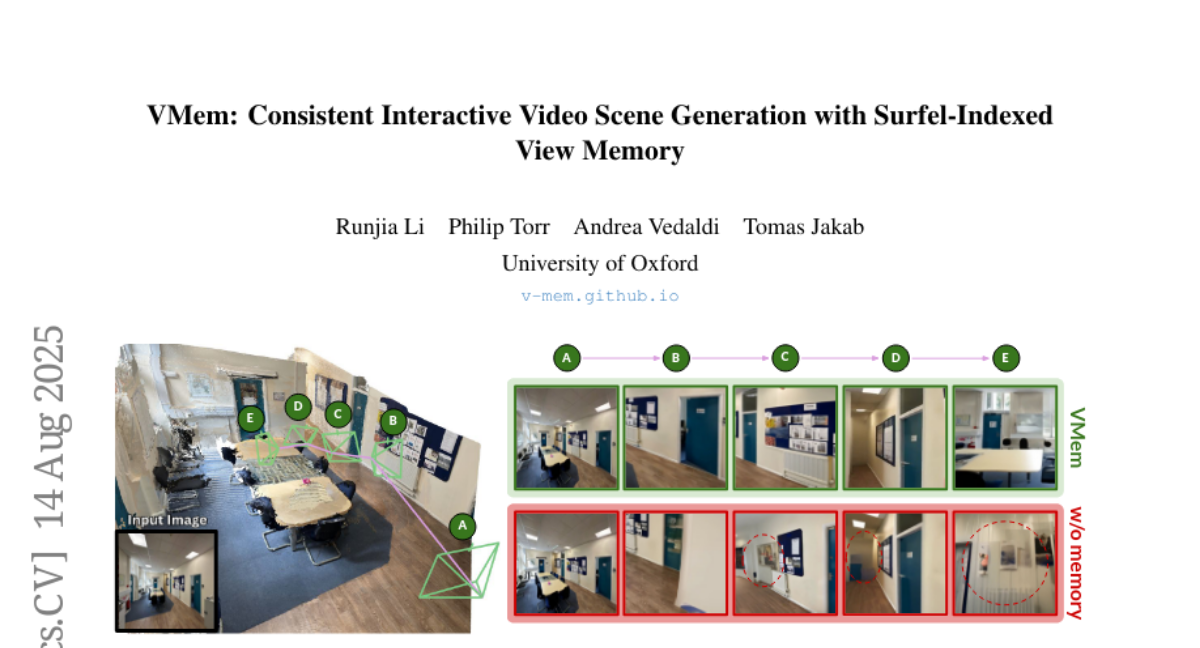
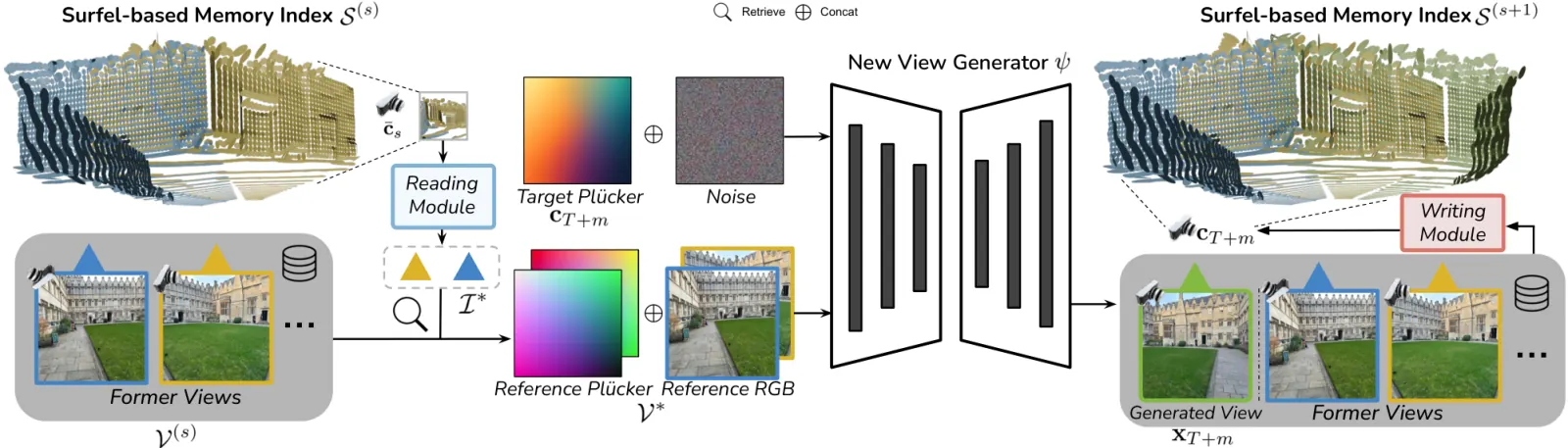
VMem is an interactive video scene generation model with a surfel-indexed view memory: as you navigate a scene, it remembers which surfaces were seen from where, keeping new views consistent with the past. Validated with the released VMem and CUT3R checkpoints: the in-tree pipeline reproduces the official navigation demo.
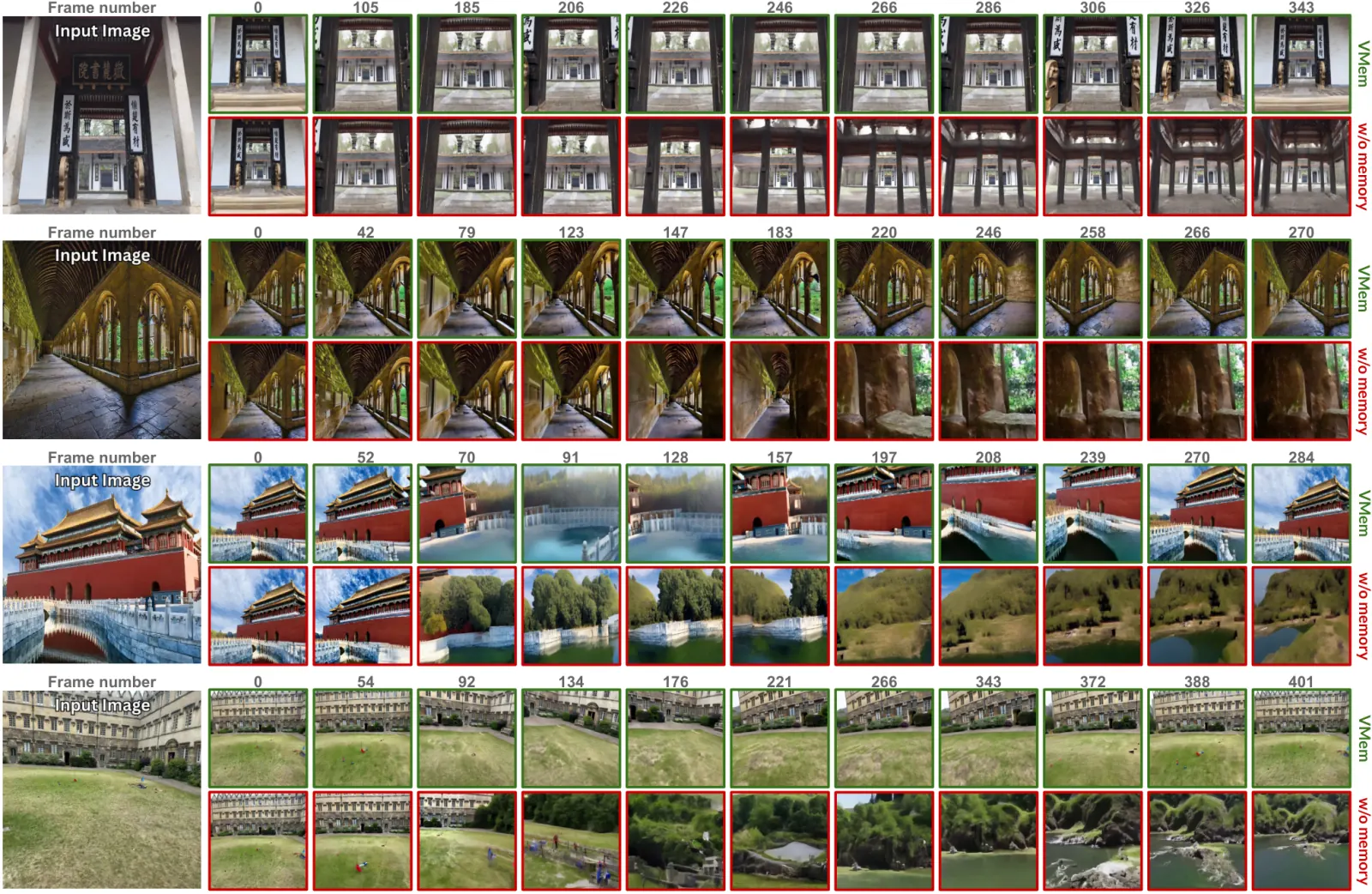
Paper: VMem: Consistent Interactive Video Scene Generation with Surfel-Indexed View Memory (ICCV 2025 highlight, 2025).
Project page: v-mem.github.io. Code: runjiali-rl/vmem.
Build your run
VMemPipelineworldfoundry.pipelines.vmem.pipeline_vmeminteractive-videoworldfoundry.pipelinewf run \
vmem \
--pipeline.task-profile interactive-video \
--jsonWhat it is for
vmem generates future frames conditioned on actions.
VMem indexes past views by surface elements (surfels) and retrieves only the relevant ones to condition generation of the next view (per the publication, arXiv 2506.18903). It uses CUT3R as its geometry backbone. It is published by University of Oxford.
Tasks: video generation, memory, stream, and interactive world model. Output modalities: video.
Suggested benchmarks: WorldScore (Scores camera-navigable generated scenes).
Runtime contract
Inputs prompt and input-path (bundled samples are used when omitted); artifacts vmem.mp4.
CLI task profiles: interactive-video. WorldFoundry binds VMemPipeline.
Family status: Verified.
Inputs are a prompt, a starting image, and navigation/interaction actions; the output is a generated video. runtime_root (or VMEM_RUNTIME_ROOT) selects only a configuration/data directory, searched for configs/inference/inference.yaml before the packaged default; config_path selects a file directly. Python code always comes from the installed package.
Requires the VMem and CUT3R checkpoints plus the Stable Diffusion 2.1 VAE and CLIP ViT-H-14 image conditioner staged locally.
Running in WorldFoundry
Run wf run vmem --pipeline.task-profile interactive-video to roll out the world model.
It runs in the unified environment worldfoundry-unified-cu128 (Python 3.11, CUDA 12.8).
Weights: liguang0115/vmem, liguang0115/cut3r, and SagiPolaczek/stable-diffusion-2-1-base among others. Prepare the environment and check local assets with bash scripts/inference/prepare_model_infer.sh vmem. Add --download to fetch missing public checkpoints.