
HunyuanVideo
Tencent open T2V/I2V DiT: prompt (and optional image) in, video out. Native WorldFoundry recipes at 720×1280, 129 frames; runner parity still pending.
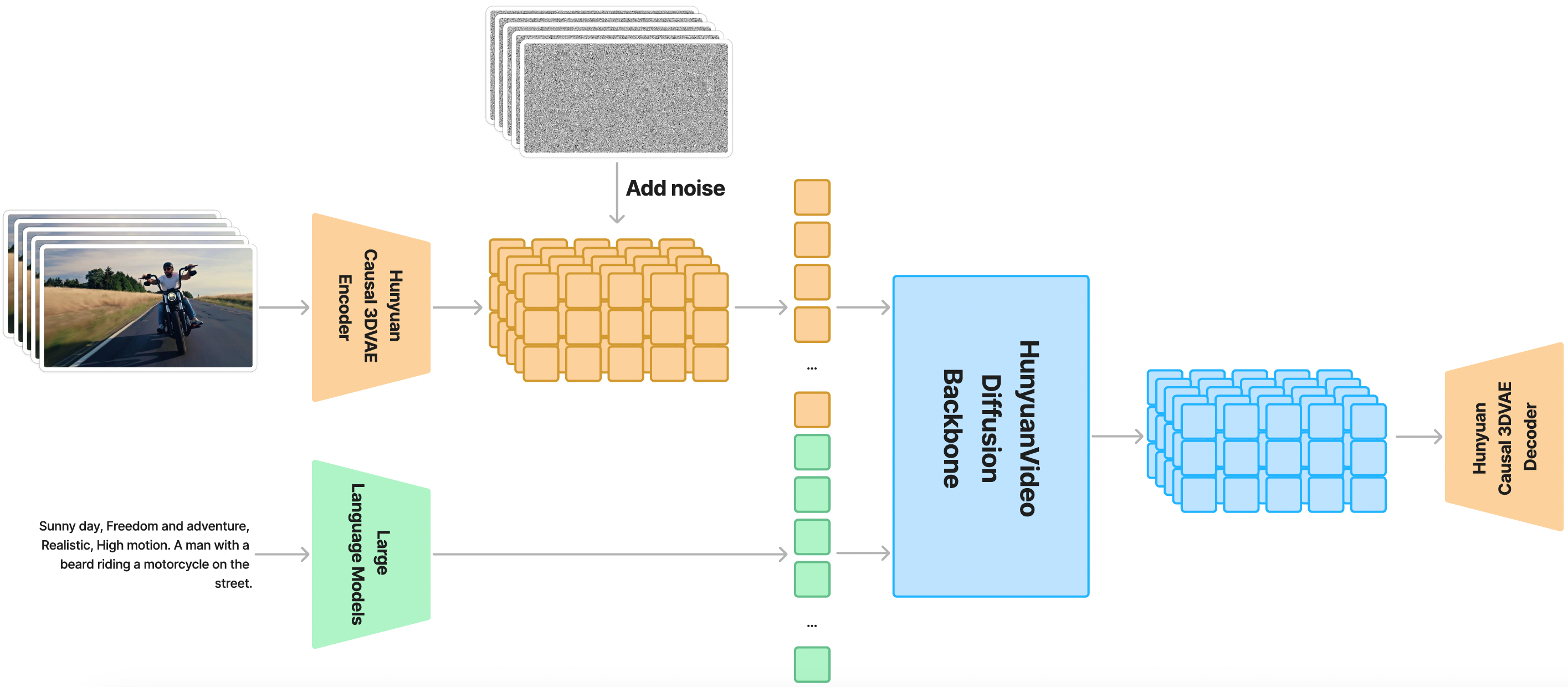
HunyuanVideo is Tencent's open video foundation model: text-to-video and image-to-video from one ~13B diffusion Transformer. At run time the generator takes Gaussian noise plus an MLLM text condition, denoises in a Causal 3D VAE latent, and decodes an image or a video.
The paper is HunyuanVideo: A Systematic Framework For Large Video Generation Model (arXiv, 2024). In the official professional human study — 1,533 prompts, one inference pass each, more than 60 evaluators — HunyuanVideo ranks above Runway Gen-3, Luma 1.6, and three top-performing Chinese video models on the overall metric, especially motion quality. That comparison uses the high-quality version, which the authors distinguish from the released fast version. Those are upstream numbers, not a WorldFoundry scorecard.
The same stack also runs as HunyuanVideo-I2V. Image-to-video reconstructs the reference image with a token-replace method and concatenates MLLM semantic image tokens with video latents for full-attention multimodal generation.
Build your run
HunyuanVideoT2VPipelineworldfoundry.pipelines.hunyuan_video.pipeline_hunyuan_videointeractive-videoworldfoundry.pipelineworldfoundry-eval run \
hunyuanvideo-t2v \
--pipeline.task-profile interactive-video \
--jsonVariants
- StatusRunner parity pending
hunyuanvideo-t2vtext-to-video
Runtime profile
hunyuanvideo-t2vPipeline binding
hunyuanvideo-t2v - StatusRunner parity pending
hunyuanvideo-i2vimage-to-video
Runtime profile
hunyuanvideo-i2vPipeline binding
hunyuanvideo-i2v
Architecture
HunyuanVideo denoises in a spatial-temporally compressed latent produced by a Causal 3D VAE. A large language model encodes the text prompt as the condition; the generator takes Gaussian noise plus that condition and outputs a latent, which the 3D VAE decoder turns into an image or a video.
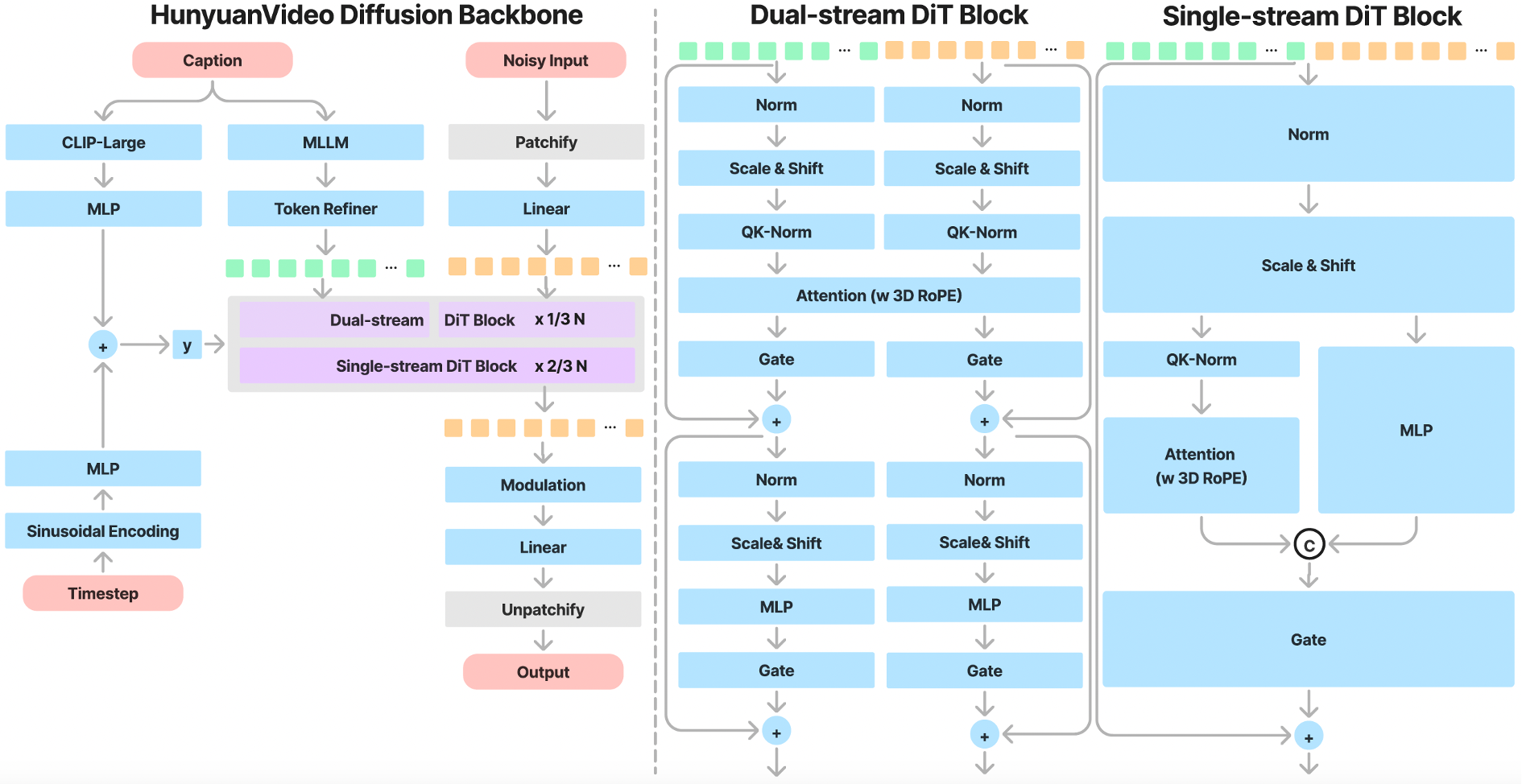
The backbone is a Transformer with Full Attention and a Dual-stream to Single-stream layout: video and text tokens first pass through separate blocks so each modality can learn its own modulation, then they are concatenated and fused in later blocks.
Text encoder
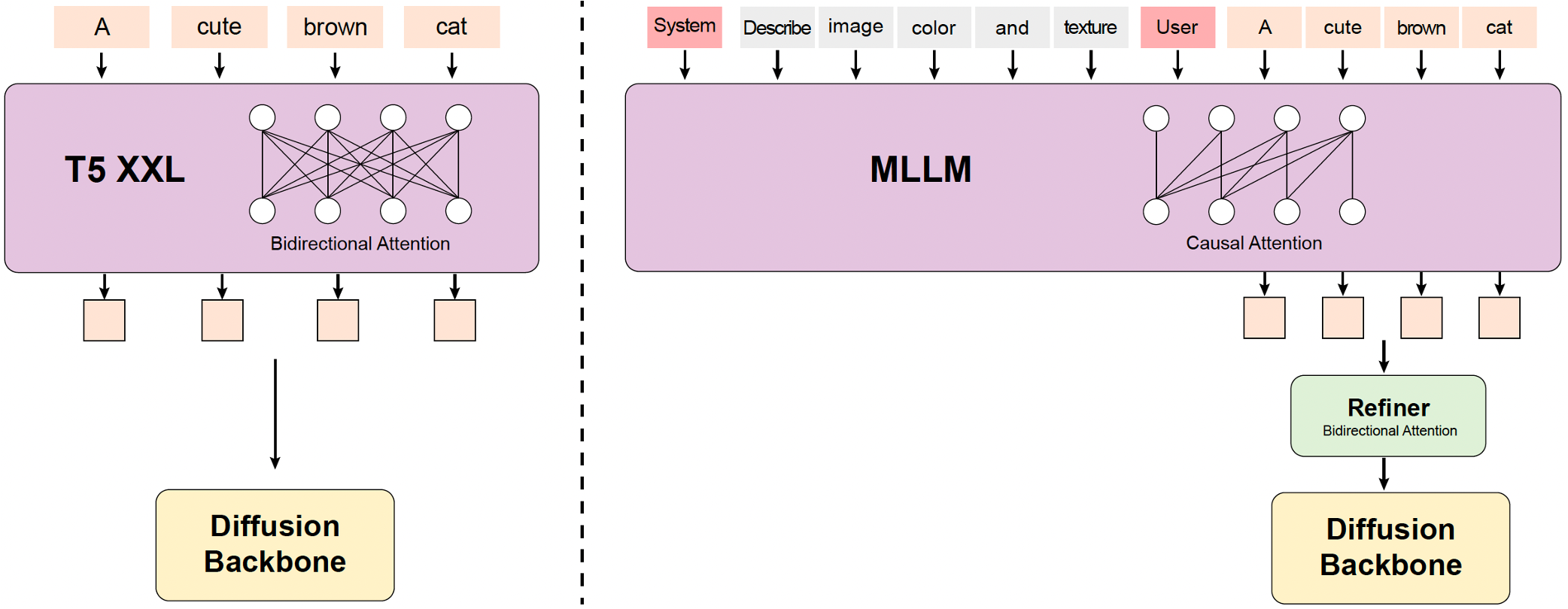
The text encoder is a pre-trained decoder-only multimodal LLM rather than CLIP or T5-XXL. It can attend to key phrases when a system instruction is prepended to the user prompt. Because the MLLM uses causal attention, an extra bidirectional token refiner is added to strengthen the text features.
Causal 3D VAE
The CausalConv3D VAE compresses pixel-space video and images by 4× in time, 8× in space, and 16 channels, so the diffusion transformer can run at the source resolution and frame rate in latent space.

User prompts vary in style and length, so a Hunyuan-Large rewrite model maps them into a form the generator prefers. Normal mode follows the user's intent more closely; Master mode adds composition, lighting, and camera movement, which can improve visual quality but sometimes drops semantic details.
Image-to-video
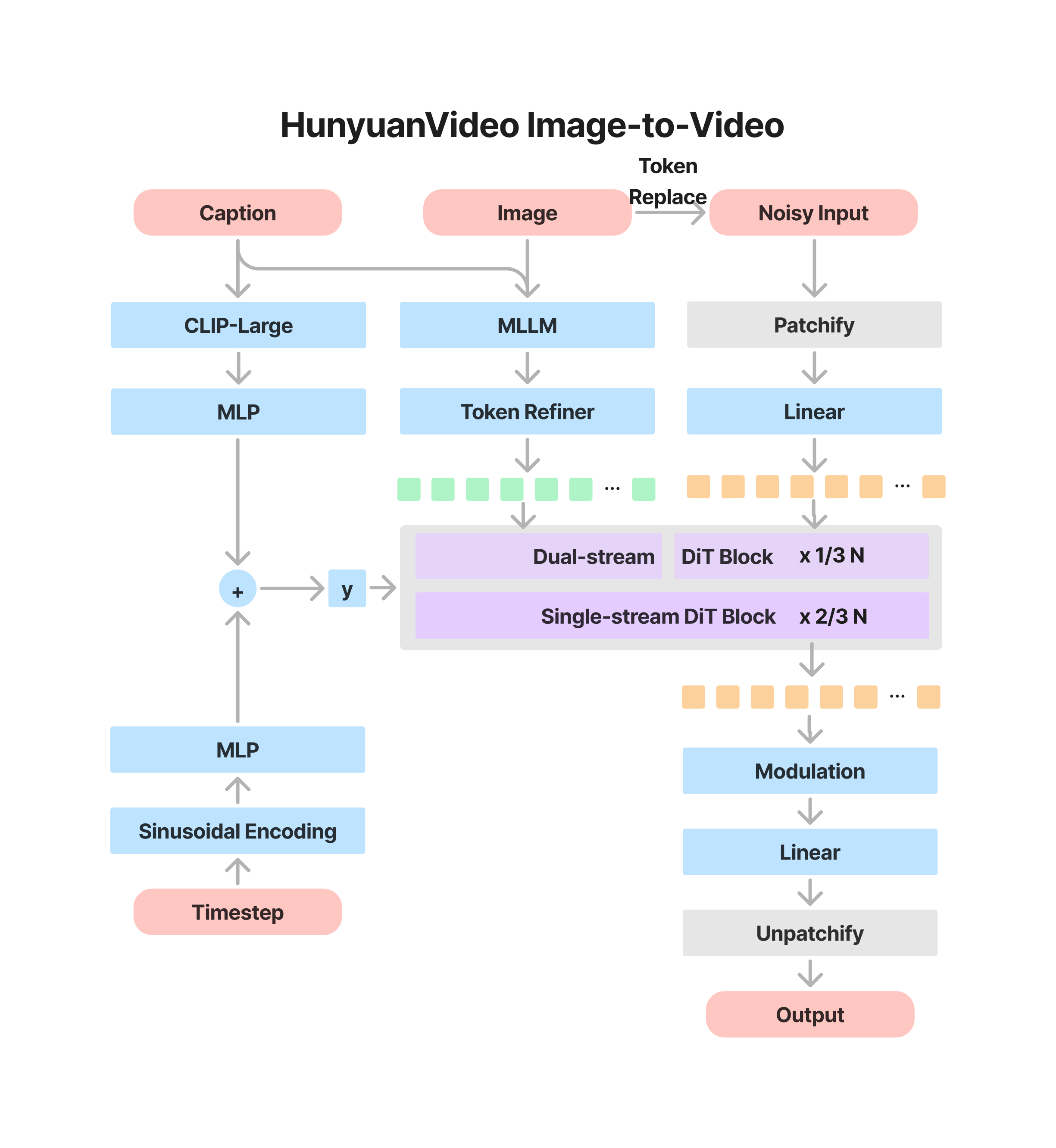
HunyuanVideo-I2V keeps this stack and inserts the reference image by token replace: the MLLM emits semantic image tokens that are concatenated with the video latents for full-attention computation across both modalities.
Inference
Official inference covers text-to-video and image-to-video at 540p and 720p (recommended), 129 frames, and 9:16, 16:9, 4:3, 3:4, and 1:1. At batch size 1 the peak memory is 60GB for 720×1280×129 and 45GB for 544×960×129; I2V at 720p is also listed at 60GB. The authors tested on a single 80GB GPU and recommend 80GB for quality. For I2V, --i2v-stability with flow-shift 7.0 gives more stable motion; turning stability off and using flow-shift 17.0 gives more dynamic motion. FP8 T2V weights save about 10GB of GPU memory.
WorldFoundry's native T2V recipe (HunyuanVideoT2VPipeline) defaults to 720×1280, 129 frames, 50 steps, 24 fps, guidance 6.0. I2V (HunyuanVideoI2VPipeline) uses the same geometry unless you pass height / width / frames. Required input is prompt; I2V also needs the reference image; actions is seed. Artifacts: hunyuanvideo-t2v.mp4 / hunyuanvideo-i2v.mp4.
In WorldFoundry
Both T2V and I2V are declarative native-diffusion recipes assembled by the shared runner — not the upstream CLI. Launch worldfoundry-eval run hunyuanvideo-t2v or the hunyuanvideo-i2v sibling. Checkpoints are tencent/HunyuanVideo and tencent/HunyuanVideo-I2V (license other on the cards). Integration is recorded; runner and demo parity are still pending, so a successful command is not the same as a checkpoint-backed GPU artifact in this workspace. Use the unified environment (worldfoundry-unified-cu128) and stage weights locally. Official 720p / 129-frame jobs want an 80 GB class GPU; plan down from there only if you accept the paper's 540p / FP8 trade-offs.
Minimal eval
T2V clips go to VBench custom_input / aesthetic_quality. Read aesthetic_quality. Runner parity is pending; a started command is not a verified GPU artifact.